Search is not the same as it was before AI came into the tech world. Instead of browsing links, people now ask questions and expect direct answers from AI platforms like ChatGPT and AI-powered search experiences from Google. This definitely changes how users discover brands, products, and information online.
It has also introduced two key strategies – Answer Engine Optimization (AEO) and Generative Engine Optimization (GEO). The former focuses on helping your content appear as direct answers to user queries, the latter focuses on making your content understandable and trustworthy for AI-generated responses and recommendations.
As AI search becomes more common, businesses need to check if their content is being picked, cited, or recommended by AI systems.
That’s where AI visibility tools help. They track your brand presence on AI platforms, measure performance, and give insights to improve your AEO and GEO strategies, so your content is easier to find in AI-powered search. Here are a few things you need to look for in an AI visibility tool.
What Should Be Looked for in an AI Visibility Tool?
Not all AI visibility tools provide the same level of insight. The best tools help you understand how answer engines and generative AI systems evaluate your content, not just how search engines rank it.
Here’s what to look for:
1. AEO Performance Tracking
A good tool should show whether your content appears as direct answers in AI results, featured snippets, and voice search responses. This helps measure your Answer Engine Optimization performance.
2. GEO Visibility Insights
They should tell how AI models interpret and use your content in generated responses.
This includes tracking:
Brand mentions in AI-generated answers
Content citations or references
Topic authority signals
How often AI recommends your brand
With these insights, you can improve your Generative Engine Optimization strategy and increase AI trust in your content.
3. AI Response Monitoring Across Platforms
Users search across multiple AI systems. The best AI visibility tools track performance across different platforms. This way, you get a broader view of your overall AI presence.
4. Content Understanding and Structure Analysis
AI models prefer clear, structured, and context-rich content. Good tools provide recommendations to improve:
Content clarity
Question-based formatting
Entity and topic coverage
Information structure
This supports both AEO and GEO improvements.
5. Competitor AI Visibility Comparison
By knowing how competitors appear in AI responses helps you identify gaps in your strategy. For example, if AI tools consistently reference competitor content instead of yours, you can adjust your content depth or structure.
6. AI + SEO Insights Together
The best AI visibility tools combine traditional SEO data with AI visibility tracking. This helps you see:
Search rankings
Answer appearances
AI mentions
Content authority
7. Simple Dashboard and Pricing Options
Clear reporting and easy dashboards help teams act faster. Many businesses also look for AI visibility tools with free plans or trials before investing.
Let’s move on to the list of the top 6 AI visibility tools.
Compare Top AI Visibility Tools in 2026
Compare the best AI visibility tools based on features, pricing, and ideal use cases to find the right fit.
Tool
Best For
Key Strength
Starting Price
Profound
Enterprise data-driven teams
Deep AI visibility tracking + AI crawler insights
$99/month
Peec
Marketing teams competitor tracking
Prompt-level AI ranking sentiment tracking
$97/month
SE Visible
Agencies global brands
Multi-country, multi-language AI monitoring
$99/month
Semrush
SEO-focused brands
SEO + AI visibility in one ecosystem
$165.17/month
Otterly.AI
Small teams GEO focus
Simple GEO audits + automated reports
$29/month
Ahrefs Brand Radar
Established SEO teams
AI share of voice + web video tracking
$199/month
6 Best AI Visibility Tools in 2026
Here’s a short comparison of the tools discussed for a quick understanding.
1. Profound
Profound is an AI visibility platform that gives you a clear understanding of your brand’s appearance across AI-powered search and answer engines. It also helps you create content that works better for AI and lets you see how AI bots interact with your website. Overall, it helps you improve your visibility, rankings, and how your brand shows up in AI-driven search.
Key Features of Profound:
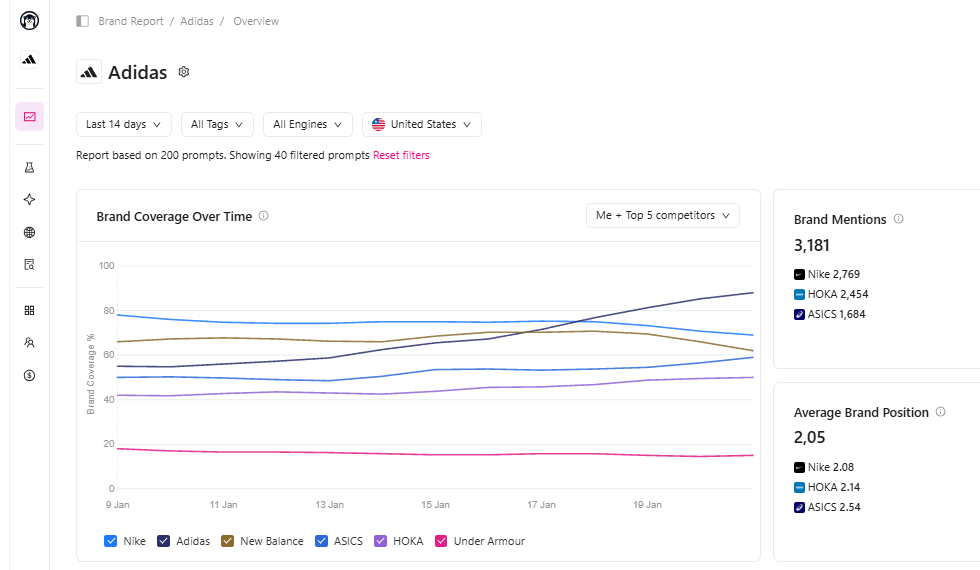
You can track how often your brand appears in AI-generated answers.
You can see what AI says about your brand, products, and topics, so you can make your messaging and positioning better.
You can check which websites and sources AI uses to generate answers about your brand.
It lets you quickly create AI-optimized content using ready-made templates like listicles, comparisons, and how-to formats that help increase your chances of getting cited.
It lets you refine your target audience by choosing specific topics, prompts, and audience segments you want to reach.
You can connect Profound with your existing tools and data sources to build custom content workflows and reporting pipelines.
You can find trending AI conversations and see what your audience is really asking AI platforms.
It helps you track your brand performance by monitoring visibility, rankings, and AI mentions over time.
You can see how AI crawlers access your website, how often they visit, and how they understand your content.
It helps you check whether your website is properly optimized for AI indexing and retrieval.
You can measure how much traffic comes from AI-driven search and find out which pages AI responses are referring to.
Pros and cons of Profound:
Pros
It provides structured insights into AI visibility, no guesswork.
The platform offers clear reporting, making it easier to explain performance to internal teams.
It helps turn AI visibility data into actionable SEO improvements.
Offer high-level security and compliance.
Cons
As the platform deals with a large amount of data and metrics, you can feel difficult to learn quickly.
Some workflows could be faster and more streamlined.
Reporting customization and export options are limited.
Recommendations could provide clearer step-by-step guidance for improvements.
Profound Pricing and Plans:
Plan
Pricing
Starter
$99/month
Growth (Popular)
$399/month
Enterprise
Custom pricing (tailored packages)
2. Peec
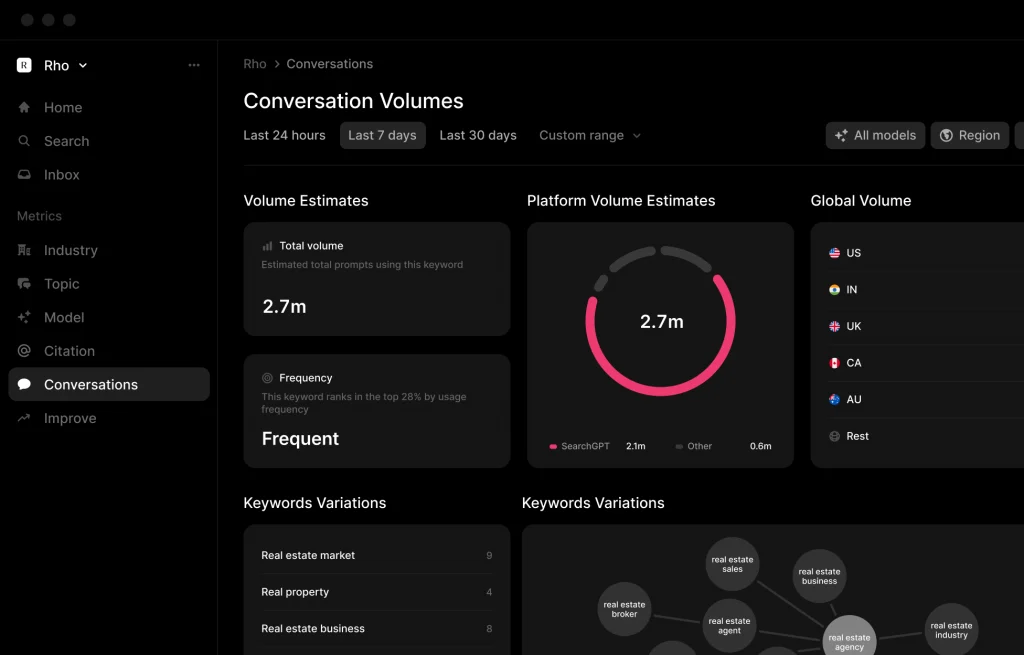
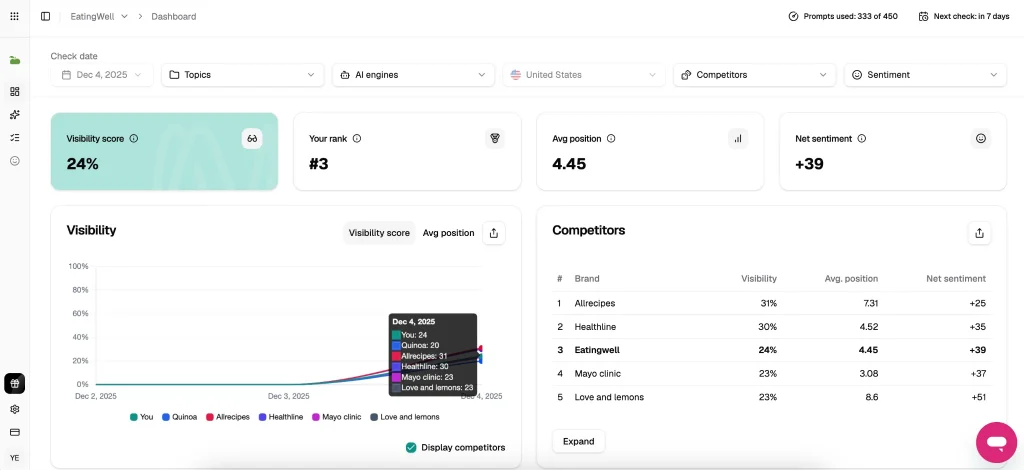
Peec focuses heavily on AI search analytics with a prompt-driven approach. It helps you understand the specific queries shaping AI conversations and how your brand ranks inside them.
The tool is practical and competitive by nature; it shows you where your competitors are winning and where you can step in. If you want clarity around AI prompts and ranking gaps, Peec leans strongly into that space.
You can track how often your brand appears in AI conversations, helping you understand your share of visibility across AI search platforms.
You can check AI sentiment about your brand to understand how AI perceives your products or services.
You can discover and organize important prompts that shape your AI search strategy.
It helps you identify high-value opportunities using AI-suggested prompts and search volume insights.
You can compare your brand performance with competitors to understand where you stand in your market.
It allows you to track rankings across multiple AI models that drive visibility and traffic.
You can identify key sources and citations that influence your AI visibility and refine your optimization strategy.
It provides recommendations that help you take action quickly and improve your AI search performance.
You can generate simple and shareable reports to present insights to your team or clients.
It allows you to export clean data files or connect with tools like Looker Studio and APIs to automate reporting and workflows.
You can track performance across multiple AI platforms from one dashboard, making monitoring easier.
Pro and cons of Peec:
Pros
It offers a free 7-day trial so you can test the full platform before purchasing.
The interface is simple and easy to navigate.
You can track exact sources and URLs that cite your brand.
You can add unlimited team members without extra cost.
Cons
It may offer limited value for new startups with low existing traffic or brand presence.
Some graph visualizations can be confusing due to similar color usage.
You cannot access historical data from before tracking begins.
There is no community forum for learning or sharing best practices.
Peec Pricing and Plans:
Plan
Pricing
Starter
$97/month
Pro (Most Popular)
$217/month
Enterprise
Custom pricing
3. SE Visible
SE Visible takes a workflow-friendly approach to AI visibility. It’s less about overwhelming data and more about making AI insights usable for teams, agencies, and decision-makers. With support for multi-country and multi-language tracking, it’s designed for brands operating across regions. If collaboration and structured reporting matter to you, SE Visible fits naturally into that environment.
Key Features of SE Visible:
You can monitor your brand across the most popular AI platforms, including ChatGPT, Gemini, Perplexity, and Google’s AI Overviews.
You get a deep sentiment analysis to see if the AI is presenting your brand in a positive, neutral, or negative light and adjust your messaging accordingly.
You can identify the exact websites and URLs that AI engines are using as sources. This shows you exactly where you need to get featured or cited to boost your own authority.
The platform allows you to view the specific questions users are asking and the full AI-generated answers.
It is easier to manage multiple clients for agencies as this tool allows you to track various brands in one place and export ready-to-use dashboards for your reports.
It offers better collaboration capabilities with your team as it supports unlimited users and offers flexible permission settings for easy sharing.
It keeps you updated on a global scale by tracking visibility across different countries like the US, UK, and Canada.
It can handle multiple languages like Spanish, German, and French.
Pro and cons of SE Visible:
Pros
The interface makes it easy to spot competitive gaps where your rivals are being mentioned instead of you.
You can automate your reporting with CSV exports and integrations, saving you hours of manual data entry.
It offers great localized tracking for brands operating in different languages or international regions.
The platform is highly secure and compliant.
Cons
Some advanced features may require time to fully understand for new users.
The monthly subscription cost can be quite high for smaller businesses or solo entrepreneurs.
While it identifies visibility gaps, you still have to do the heavy lifting of content creation to fix them.
SE Visible Pricing and Plans:
Plan
Pricing
Basic
From $99/month
Core
From $189/month
Plus
$284/month
4. Semrush
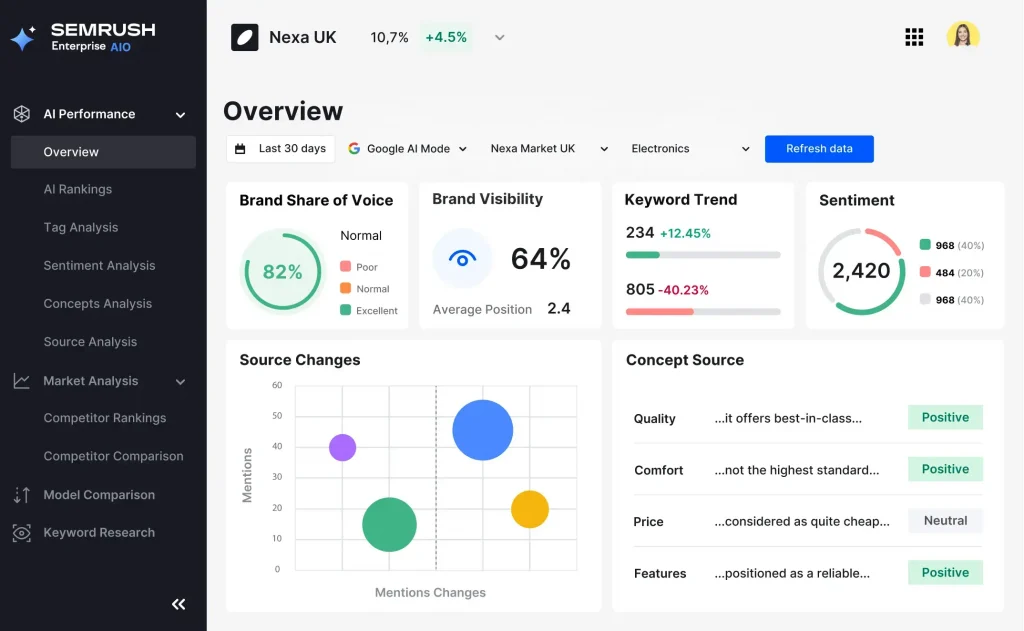
If you have used SEO tools before, you have definitely heard of Semrush, but they have recently leveled up to help you master the world of AI search. Their AI visibility suite is designed to show you exactly how your brand ranks in LLM (Large Language Model) responses and where you have room to grow.
By blending their legendary SEO data with these new AI insights, Semrush helps you bridge the gap between traditional search and the future of AI-driven answers.
You can monitor your brand’s overall visibility and share of voice across various AI platforms. It gives you clarity on which task needs to be prioritized.
It helps you discover the actual prompts your audience is using across different industries. You can tailor your content to answer the questions people are truly asking AI.
You can find the visibility gaps by spotting exactly where your competitors are being mentioned or cited while you’re being left out.
The tool analyzes the sentiment of your brand mentions, helping you understand if AI platforms perceive your brand positively or if there are ‘blind spots’ you need to fix.
You can track daily visibility for your most important prompts and receive specific, actionable recommendations on how to get cited more often.
It allows you to perform ‘AI readiness’ audits on your content, ensuring your website is structured in a way that AI engines can easily crawl, understand, and trust.
Soon, you will be able to connect your Google Analytics to see exactly how your AI visibility efforts are translating into real website traffic and conversions.
Pros and Cons of Semrush:
Pros
It combines traditional SEO insights with AI visibility tracking in one platform.
The prompt-level analysis is incredibly detailed, showing you the exact triggers that lead to brand mentions.
You get highly personalized metrics, like keyword difficulty scores that are tailored specifically to your website’s authority.
Cons
The tool is relatively expensive, with additional add-on costs.
User access can be limited, even in higher-tier plans.
Some users report occasional fluctuations in data accuracy.
Semrush Pricing and Plans:
Plan
Pricing (Billed Annually)
Starter
$165.17/month
Pro+
$248.17/month
Advanced
$455.67/month
5. Otterly.AI
What makes Otterly.AI stand out is its specialized focus on Generative Engine Optimization (GEO), helping you move beyond traditional SEO into the world of conversational search. It’s designed to be approachable, so you don’t need to be a data scientist to understand why your brand is or isn’t showing up in AI-generated answers.
Key Features of Otterly.AI:
Automation helps you track your brand mentions and specific website citations across a wide range of platforms. It includes ChatGPT, Gemini, Perplexity, and Microsoft Copilot.
You get a GEO Audit tool that checks many on-page factors and shows what’s stopping your site from getting more AI citations.
It lets you track brand sentiment and position, so you can see if AI is talking about your brand in a better way over time.
You can set up automatic weekly reports that come straight to your inbox, so your team doesn’t have to search for data manually.
It offers country-level tracking, so you can see how your AI visibility changes in different regions.
You can connect it with tools like Google Search Console, Slack, or HubSpot to understand how AI visibility impacts your leads.
Pro and cons of Otterly.AI:
Pros
Its simple dashboard makes AI visibility tracking easy, even for non-technical users.
The platform is under active development, meaning new features and AI engines are added regularly to keep you ahead of the curve.
The platform is incredibly quick and easy to implement and integrate with existing tools.
Cons
Sentiment analysis may sometimes mark neutral mentions as slightly negative.
Some metrics and insights require time to fully understand.
New users may take a little time to understand performance data.
Otterly.AI Pricing and Plans:
Plan
Pricing & Best For
Lite
$29/month – Ideal for solo marketers and small teams
Standard
$189/month – Suitable for SMEs and small marketing teams
Premium
$489/month – Designed for mid-sized businesses and agencies
6. Ahrefs Brand Radar
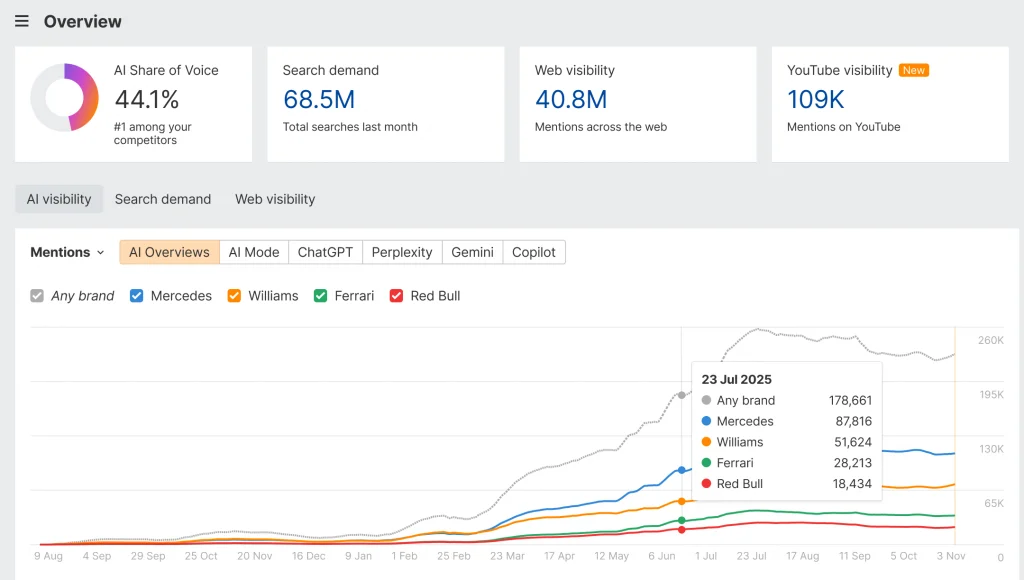
If you are already a fan of Ahrefs for your standard SEO, you will find Ahrefs Brand Radar to be a natural and powerful evolution for the AI era. It doesn’t just stop at tracking ChatGPT or Gemini; it actually scours high-impact platforms like YouTube, TikTok, and Reddit to see where your brand is being discussed in the wild. Overall, it helps you improve brand awareness and reach new audiences through AI-driven search.
You can discover your ‘AI Share of Voice,’ which tells you exactly what percentage of AI-driven chats and queries actually mention your brand versus your competitors.
It helps you track which websites and publications AI engines use as sources, so you know where you should try to earn backlinks.
You can monitor brand mentions on platforms like YouTube and TikTok, including video titles, descriptions, and transcripts.
It lets you find popular subreddits where your brand is being discussed, so you can see how Reddit conversations may influence Google results.
You can compare your brand with top competitors to find visibility gaps and see which conversations you’re missing.
It helps you group AI prompts into topics, making it easier to spot new content ideas your competitors may have overlooked.
You can also add custom prompts to track how AI answers specific questions related to your business or niche.
Pro and Cons of Ahrefs Brand Radar:
Pros
You get comprehensive tracking across AI platforms, content sources, and social channels.
It integrates easily with the broader Ahrefs SEO ecosystem.
It provides very granular data on citation frequency, helping you see exactly how often you’re being used as a primary source.
The tool is excellent at identifying ‘AEO’ opportunities that help you rank higher in AI-generated summaries.
Cons
The tool is premium-priced and may be expensive for smaller businesses.
Occasional data accuracy issues have been reported by some users.
Customization options may be limited compared to specialized AI visibility tools.
Ahrefs Brand Radar Pricing and Plans:
Plan
Pricing Details
Individual Platforms
$199/month per index
All AI Platforms
$699/month (Access to all AI platform indexes)
Conclusion
AI is transforming how information is discovered online. Users are shifting from traditional search results to AI-generated answers, summaries, and recommendations. This change makes visibility inside AI platforms just as important as search rankings.
AI visibility tools help businesses understand how AI systems interpret their content, measure brand presence, and improve discoverability through GEO and SEO strategies. They provide insights that traditional analytics alone cannot offer.
As AI-driven discovery continues to grow, businesses that invest in the best AI visibility tools will gain a competitive advantage. By tracking performance, optimizing content, and adapting to new search behaviors, you can build a stronger, smarter, and more future-ready digital presence.






 Previous