What is Advanced Planning and Scheduling Software? Features, Benefits & Tools

In manufacturing, one thing goes wrong, like a machine breakdown or a shipment getting late, it can disrupt the whole schedule.

An advanced planning and scheduling software, often called APS, is the solution to plan and schedule the manufacturing process in a better way.

It’s high time to say goodbye to spreadsheets or basic whiteboards to run your shop floor. It can make things probably feel pretty chaotic in the growing tech world.

This guide is going to break down what an advanced planning system software is, why it’s required in manufacturing, and which tools are actually worth your time.

Let’s begin.

What is Advanced Planning and Scheduling Software?

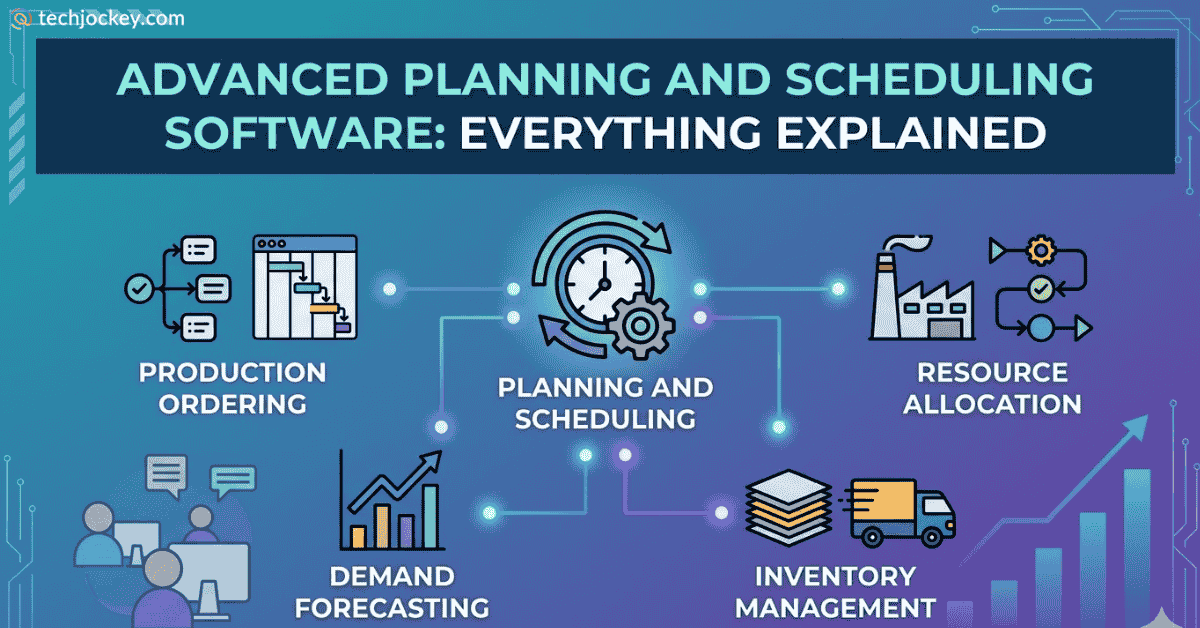
An advanced planning and scheduling software can be explained as a digital tool that helps manufacturers manage their production faster.

This clarifies when and how to make a product based on the resources you actually have. It can be said as the ‘brain’ of a factory. It looks after your available machines, labor, and raw materials and then creates a realistic schedule. Unlike basic systems that assume you have infinite capacity, an APS knows that a machine can only do one thing at a time and that workers need breaks.

Key Features of Advanced Planning and Scheduling Software

We have covered the top tools in the coming sections, but before that, we will discuss some key features of an advanced planning and scheduling software.

  • Finite Capacity Scheduling: This ensures the software never schedules more work than a machine or a person can actually do in a set time.
  • Constraint-Based Modeling: This allows you to program in specific rules. For example, if you set a rule that ‘Product A cannot be made after Product B without a 2-hour cleaning.’
  • Real-Time Production Visibility Dashboard: You need to be able to see the schedule instantly. With Gantt Charts, you can see a visual timeline that is much easier to understand than a thousand rows of data.
  • Advanced Scheduling Optimization Algorithms: These software look at millions of possibilities to find the most efficient way to run your factory, saving time and reducing waste.
  • Production KPI Monitoring and Bottleneck Analysis: The system can track how well the manufacturing process is going on and tells you where the things are slowing down. By finding these bottlenecks, you can fix problems earlier without disrupting production.
  • Demand and Capacity Alignment Planning: This module makes sure your schedule matches what customers want. It also links with your warehouse data, because a schedule is only useful if you actually have the parts to build the product.

Working of Advanced Planning Scheduling Software

The operation of advanced planning and scheduling software is not as complicated as you might think. Let me explain it in simple sentences.

It usually follows a few key steps:

  • Data Input: The software pulls information from your other systems, like your ERP or CRM. It looks at new orders, current inventory levels, and how many people are on the clock.
  • Constraint Mapping: This is the advanced part. You tell the software your constraints. For example: ‘Machine A is faster than Machine B,’ or ‘This specific part needs to cool for two hours before the next step.’
  • Synchronization: The software aligns all these moving parts. It ensures that the materials arrive just as the machine becomes free, so nothing sits around idle.
  • Optimization: It runs ‘what-if’ scenarios. If a big rush order comes in, the software can instantly recalculate the entire schedule to see if you can squeeze it in without ruining your other deadlines.

I hope you have understood the process. Let’s now move on to the benefits an advanced planning and scheduling system offers.

The Major Benefits of Using APS Software

Switching to advanced scheduling software is not just about being highly technical. It has real-world benefits. Here we go…

  • Better On-Time Delivery: When your schedule is realistic, you stop making promises to customers that you can’t keep. You’ll know exactly when a job will be finished.
  • Reduced Waste: When things are planned perfectly, you don’t have piles of raw materials sitting on the floor taking up space, and you don’t have workers standing around waiting for a part.
  • Lower Costs: By maximizing how much your machines are running and minimizing setup times, you get more out of your investment without spending more on overhead.
  • Stress Reduction: Let’s be honest – running a plant is really stressful. Having a clear, visual schedule that everyone can see makes the workday much smoother for managers and operators alike.

Now that you know what advanced planning and scheduling software is, its benefits, and how it works, we have some of the best tools on the list.

Top 5 Advanced Planning and Scheduling Software

Here are five of the top players that are making waves in the manufacturing world right now.

1. SYSPRO

SYSPRO is a well-known name in the ERP world, and its Manufacturing Operations Management (MOM) suite includes very strong APS capabilities. It’s built specifically for manufacturers, so it speaks the right language.

Key Features:

  • Visual production scheduling that lets you drag and drop tasks
  • Full integration with inventory and purchasing
  • Capability to track Work in Progress in real-time
  • Inventory optimization to ensure you aren’t overstocked

2. Siemens Opcenter

Siemens is a giant in the industrial world, and Opcenter, formerly Preactor, is one of the most widely used APS systems globally. It’s highly flexible and can handle incredibly complex manufacturing environments.

Key Features:

  • Interactive drag-and-drop Gantt charts for easy adjustments
  • Finite capacity scheduling that accounts for real-world limits
  • Advanced ‘What-If’ analysis to test different production scenarios
  • Advanced logic to minimize machine changeover times

3. PlanetTogether

PlanetTogether focuses heavily on making the scheduling process as visual and intuitive as possible. It’s designed to bridge the gap between your high-level planning and the actual chaos of the shop floor.

Key Features:

  • Multi-plant scheduling for companies with more than one factory
  • Automated scheduling heuristics that find the best path forward
  • Instant visibility into how a delay in one area affects the whole plant
  • Seamless integration with most major ERP systems like SAP and Microsoft Dynamics

4. SAP S/4HANA (Resource Scheduling)

For larger enterprises already using SAP, their S/4HANA resource scheduling module is a powerhouse. It’s built into the core system, meaning your data is always up to date without any syncing issues.

Key Features:

  • Real-time monitoring of work center utilization
  • High-level capacity leveling to prevent employee burnout
  • Direct link between maintenance schedules and production schedules
  • Mobile-friendly views for floor managers on the move

5. Skyplanner

Skyplanner is a modern, AI-driven approach to APS. It uses an AI called ‘Artemis’ to help calculate the best possible production plan in seconds. It’s a great fit for smaller to mid-sized shops that want something fast and smart.

Key Features:

  • AI-powered optimization that learns from your production patterns
  • Cloud-based platform, making it easy to access from anywhere
  • Simple, user-friendly interface that doesn’t require a Ph.D. to operate
  • Quick implementation compared to some of the larger legacy systems

Why Spreadsheets Are Ruining Your Production?

Excel is great for math, but it’s terrible for time.

Spreadsheets are static. The moment you print a spreadsheet and walk it out to the floor, it’s already out of date. If a worker calls in sick, you have to manually find every cell affected by that change.

Advanced scheduling software is dynamic. When one thing changes, everything else shifts automatically to compensate.

Also, spreadsheets don’t have memory. They don’t know that Machine C always takes 20 minutes longer to warm up in the winter. An APS system keeps track of these details, making your plans more accurate over time.

Future Trends: AI and APS

We are starting to see Smart Factories where the machines actually talk directly to the advanced scheduling software.

In the near future, if a machine senses it’s about to overheat, it will tell the APS. The software will then automatically move the next job to a different machine and schedule a repair technician, all before a human even knows there’s a problem. Tools like Skyplanner are already moving in this direction with AI, and it’s only going to get more common.

Final Thoughts

Investing in advanced planning and scheduling for manufacturing is one of the best ways to automate your manufacturing business. No matter if you choose a heavy-duty system like Siemens or a smart, AI-driven tool like Skyplanner, their final goal is to make you work smarter.

By giving your team a clear, realistic map of the day, you’ll reduce stress, save money, and, most importantly, keep your customers happy with on-time deliveries. If you are tired of the fire-fighting mentality on the shop floor, it might be time to let an advanced planning system do take care of heavy tasks for you

Mehlika Bathla

Mehlika Bathla is a passionate content writer who turns complex tech ideas into simple words. For over 4 years in the tech industry, she has crafted helpful content like technical documentation, user guides, UX content, website content, social media copies, and SEO-driven blogs. She is highly skilled in SaaS product marketing and end-to-end content creation within the software development lifecycle. Beyond technical writing, Mehlika dives into writing about fun topics like gaming, travel, food, and entertainment. She's passionate about making information accessible and easy to grasp. Whether it's a quick blog post or a detailed guide, Mehlika aims for clarity and quality in everything she creates.

Share
Published by
Mehlika Bathla

Recent Posts

What is a Revenue Intelligence Platform?

If you work in sales, marketing, or revenue operations, you have probably felt that nagging…

6 hours ago

Top 6 AI Recruitment Software for Faster Hiring

Key Takeaways AI recruitment software makes the process of recruiting much faster by automating sourcing,…

3 days ago

Top 5 Manufacturing Operations Management Software to Improve Factory Efficiency

Manufacturing Operations Management (MOM) software is a complete digital toolset built to make your factory…

5 days ago

Top 5 Property Management Tool in 2026

It can be overwhelming many times to manage rental properties. Tasks such as collecting rent,…

1 week ago

Top 7 Electronic Signature Platforms to Simplify Digital Document Signing

Let’s be honest, printing documents, signing them, scanning them, and emailing them back feels like…

2 weeks ago

Space Management Software: Features, Benefits & Top Tools

Putting your office space to good use isn’t an easy task to accomplish. For, as…

2 weeks ago
