December 16, 2025
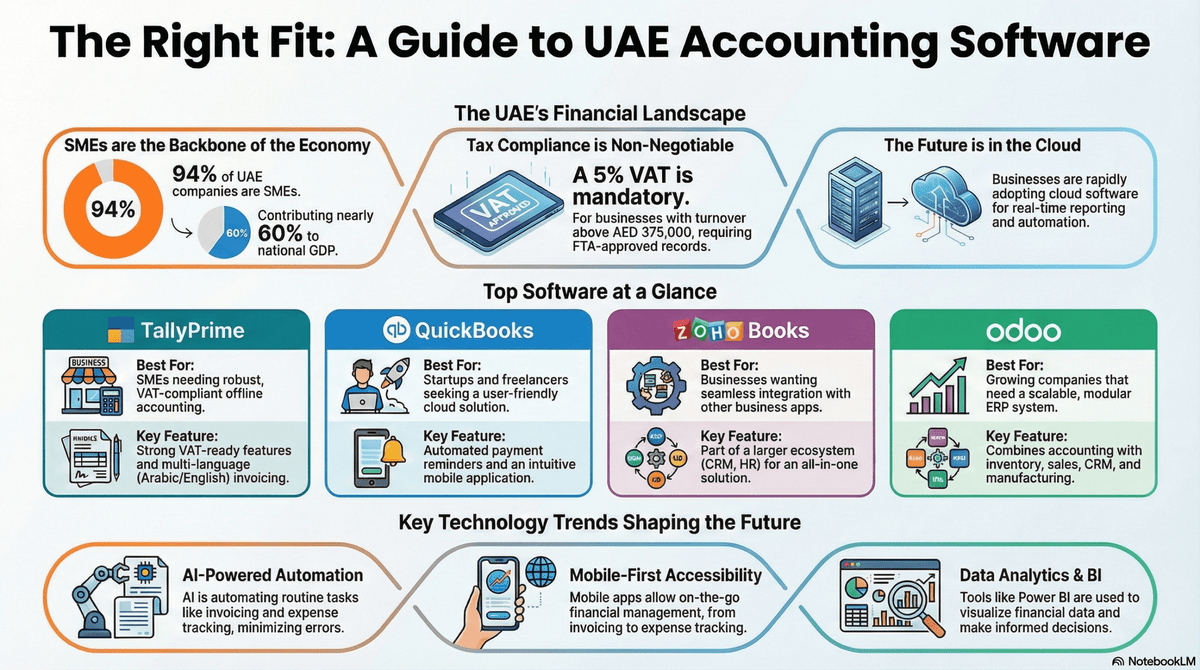
Whether you are launching a startup or managing an established business, accounting is non-negotiable especially in the UAE where VAT rules and complex business regulations are constantly in play. For the over 94% of companies in the UAE that are SMEs (contributing nearly 60% to the GDP), having reliable bookkeeping software is not just helpful; it is a must for staying compliant, boosting productivity, and securing growth.
So how do you choose the right digital partner when faced with a sea of options, here’s a guide to choosing accounting software in UAE for your business.
Dealing with numbers can quickly become messy; a missing invoice or a sneaky tax deadline can quickly escalate into the worst-case scenario: an audit notice. In the UAE market (2025-2026), your chosen software must be tailored to meet stringent local requirements.
The essential regulatory demands your software must handle include:
1. VAT Compliance: Since the introduction of the 5% VAT in 2018, all eligible businesses (turnover above AED 375,000) must maintain FTA-approved VAT records and ensure timely filing.
2. Accounting Standards: Businesses in Dubai typically use the accrual accounting method and must comply with the International Financial Reporting Standards (IFRS).
3. Modernizing Operations: Many solutions now support ZATCA, corporate tax, and e-invoicing capabilities to ensure seamless adherence to evolving laws.
4. Global Trade: Given the UAE’s reliance on global trade (especially with the GCC, Asia, and Europe), multi-currency transaction support is crucial.
The solution lies in embracing the digital transformation trends, particularly the rapid adoption of cloud accounting software to meet needs for automation and real-time reporting.
Modern accounting is defined by speed, accuracy, and accessibility. The best systems leverage technology to move you away from tedious manual data entry.

Astro Health Scope
Starting Price
$ 170.00
• Cloud Power: Platforms like Zoho Books and QuickBooks Online offer the flexibility and scalability needed for UAE startups, allowing access to financial data anytime, anywhere. Cloud-based systems ensure your data stays synced and secure, whether you are on your desktop or mobile device.
• Automation is Key: Integrating AI and machine learning helps automate routine tasks such as invoicing, payroll, and expense tracking, significantly minimizing human errors and allowing your team to focus on strategy. Solutions like Elate automatically pull in data, set reminders, and generate reports.
• Integrated Solutions: Instead of juggling multiple apps, platforms like Odoo and ERPNext offer all-in-one solutions that combine accounting with inventory, CRM, HR, and sales, streamlining processes and reducing data silos.
While there is no single “one-size-fits-all” answer, specific software excels based on business size and complexity.
1. The Trusted SME Workhorses
• TallyPrime: This is one of the most widely used accounting software programs in Dubai and the UAE, especially for small to mid-sized businesses (SMEs). It is highly regarded for its affordability, robust VAT-ready features, and simplicity. TallyPrime allows for efficient multitasking with its “GoTo” feature and offers multi-language invoice generation, useful for Dubai’s diverse business crowd.
• QuickBooks: Popular globally and regionally, QuickBooks Online is gaining traction among UAE freelancers and service providers looking for cloud flexibility. It provides clear, visual dashboards and uses automated reminders to help you chase payments manually less often. QuickBooks also allows users to run multiple businesses and get consolidated reports with a single login
2. The Scalable & ERP-Ready Solutions
• Odoo: Best known for its modular ERP integration. If your goal is to have accounting plug seamlessly into other core functions like inventory, sales, and HR, Odoo is a top choice. It simplifies management for businesses running multiple companies and handles overseas transactions easily with built-in multi-currency support.
• Elate Accounting Software: This platform excels at enterprise needs, managing multiple companies and entities simultaneously. It is noted for streamlining all corporate processes on one cloud platform and is specifically designed to match UAE regulations, with powerful e-invoicing features to keep finances up-to-date and compliant.
3. The Budget-Friendly & Cloud-Native Options
• Zoho Books: An ideal choice for those prioritizing cloud-based automation and VAT compliance. It uses auto bank sync to pull in real-time data for easy reconciliation and allows you to set up approval workflows for key payments. The annual standard plan is affordably priced for local businesses.
• WAVE: Perfect for small business owners and freelancers who need a simple, budget-friendly solution. The core features- invoicing, accounting, and reports are offered totally free. It is fully cloud-based, making it incredibly accessible via mobile devices.
Choosing the right software is like hiring a dedicated finance partner; you need one that understands the complexities of the UAE market, handles compliance automatically, and grows with your vision. By prioritizing cloud access, compliance features, and genuine scalability, you ensure your business foundation is built on accurate, trustworthy data, allowing you to focus on growth rather than paperwork.
An integrated accounting system is a software solution that consolidates various financial accounting functions within a single application, streamlining processes by eliminating the need for separate systems for ordering, costing, and management accounting purposes.


Consult with Our Techjockey Expert
Connect for fast and scalable software delivery, corporation plans, advanced security, and much more.
Compare Popular Software

Get the latest Techjockey UAE Blog Updates!
Subscribe to get the first notified about tech updates directly in your inbox.