February 4, 2026
Can you even imagine that the AI market size is going to be around USD 1 trillion by 2031?
From data-driven models that simply recognized patterns to creative systems that could write, draw, and code, AI has come a long way!
But 2026 has marked a clear turning point. AI is no longer just creating; it has started to act.
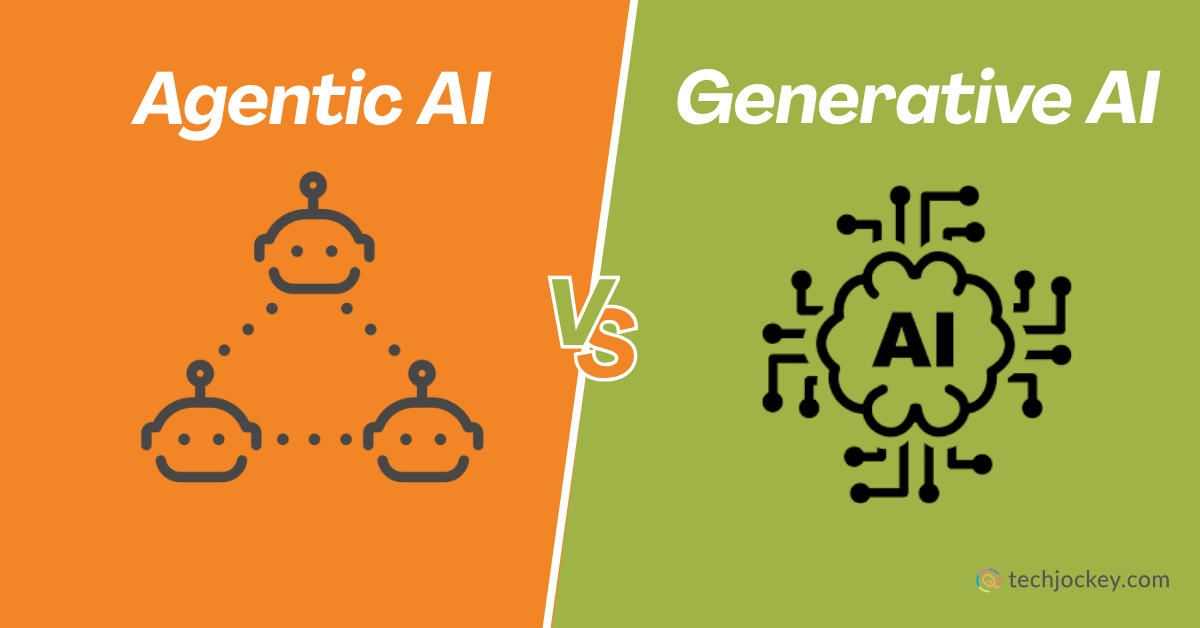
That’s where Agentic AI comes in. While Generative AI gave machines the power to generate ideas and content, Agentic AI gives them the ability to reason, plan, and take action. It’s almost like having an autonomous digital assistant that can think ahead.
This blog will take you through Agentic AI vs Generative AI – their evolution, purpose, how they work under the hood, and why this shift is being called the next revolution in artificial intelligence.
To understand where AI is going, we need to look back at where it started.
Generative AI was the AI turning point when tools like ChatGPT entered the market. It taught machines how to create human-like text, stunning images, code snippets, or even videos with just a small prompt. Other tools like DALL·E, Google Gemini, and GitHub Copilot are also in this list.
But as powerful as it was, Generative AI had one big limitation: it could only respond to prompts. It cannot perform the next step itself.
That’s where Agentic AI steps in! It’s the next phase of evolution. Instead of just generating outputs, Agentic AI can make decisions, plan multi-step actions, and complete tasks without constant human direction.
You can see this evolution in real products:
Agentic AI builds on the foundation of Generative AI, but adds a layer of autonomy and intelligence that can accomplish complex tasks.

ChatGPT
Starting Price
$ 20.00
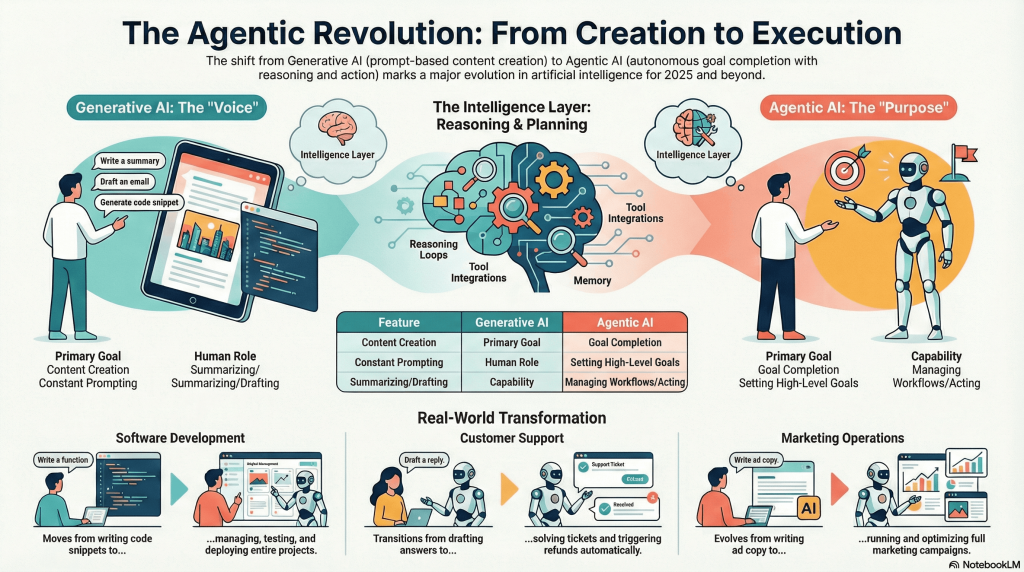
Generative AI focuses on producing content, turning prompts into results. It can write an article, design an image, compose music, or summarize documents.
Agentic AI, on the other hand, doesn’t stop at creation. It’s designed to achieve goals. It can reason, make plans, and take actions that move toward a result.
For example, a generative model might write an email for you. An agentic model would draft, send, and even follow up on that email automatically.
This shift changes AI’s role from being assistive to autonomous.
Understanding the architecture of Agentic AI vs Generative AI is important, so you know how your favorite tools work.
Under the hood, both types of AI run on some of the same core technologies, but the way they use them is very different.
Generative AI systems are powered by large language models (LLMs) and transformer architectures. They are trained on massive datasets of text, code, or images, learning patterns that help them generate realistic content. Diffusion models like Stable Diffusion or Midjourney use similar methods to create visuals from scratch.
These models are excellent at recognizing and replicating patterns, but they don’t really plan ahead. They can also predict what the user wants next. This coins another term – ‘Predictive AI’ that’s incorporated in Generative AI. The comparison between Agentic AI vs. Generative AI vs. Predictive AI is another interesting topic to upgrade your AI knowledge.
Let’s now move on to the working of Agentic AI.
Agentic AI, in contrast, adds extra layers on top of these generative models. It combines LLMs with:
For instance, systems like AutoGPT, Devin, or CrewAI use reasoning loops to plan tasks, break them down into steps, and use tools to get results, not just generate text.
Both Generative and Agentic AI are powerful in their own ways, but both have their individual capabilities in different areas.
Generative AI is all about only creation. It can write blogs, summarize data, generate images, draft code, or even compose music. But once it creates the output, its job is done. It doesn’t take the next step or make decisions about what to do with that output.
Agentic AI, on the other hand, is like a digital helper. By using the data created by generative systems, it acts on it. It plans, reasons, and uses external tools to complete tasks or even manage workflows on its own.
That’s the key difference: ‘creation vs execution’.
Of course, both have their limits. Generative AI struggles with reasoning and task completion, while Agentic AI depends on clear goals, reliable data, and tight safety controls. If it isn’t guided properly, it might take wrong actions or use tools incorrectly.
Now, let’s see how both AIs behave in real-world scenarios across industries.
In Marketing
In Software Development
In Customer Support
Generative AI: Answers user questions or drafts responses.
Agentic AI: Solves tickets, triggers refunds, updates CRM data, and notifies customers when issues are resolved.
Agentic AI is built on the solid foundation of Generative AI.
At its core, every Agentic AI system still uses a large language model (like GPT-4 or Claude) to understand and generate language. What makes it ‘agentic’ is the extra intelligence layer that gives it autonomy.
This layer allows the system to:
For example, GPT-4 Turbo can now act like an agent. It can browse the web, write code, schedule meetings, and more.
As with every big leap in technology, both Generative and Agentic AI come with their own set of challenges.
Generative AI faces issues we’ve already seen, like factual errors, data bias, and content misuse. Since it learns from massive datasets, it can sometimes reproduce mistakes or reflect biased patterns from its training data. It’s great at sounding confident, even when it’s wrong.
Agentic AI, though, brings a new layer of complexity. Because it can act on its own, it raises security and safety concerns.
If not controlled properly, an autonomous agent could execute wrong commands, misuse connected tools, or access sensitive data unintentionally.
There’s also the risk of over-autonomy, i.e., giving AI too much freedom without enough guardrails. A well-meaning agent might try to solve a problem but end up causing more issues if it doesn’t understand the context fully.
That’s why human oversight remains essential. Even the smartest AI needs guidance, boundaries, and ethical frameworks. The future of Agentic AI will depend on how safely we design these systems, so they are powerful and responsible in their actions.
We are moving toward a world where users won’t have to prompt or micro-manage AI models. Instead, you just need to assign goals, like ‘build me a website’ or ‘analyze last month’s sales’, and the AI will plan and execute the whole process.
Generative and Agentic AI will likely merge into one ecosystem, where creativity, reasoning, and action coexist. These intelligent agents will collaborate, share memory, and complete complex tasks across apps and workflows.
Industries that depend heavily on decision-making and automation, such as software engineering, business operations, customer service, and research, are already seeing early transformation.
Conclusion
Generative AI adds creativity to technology; it gives machines the ability to think, write, and design.
Agentic AI adds autonomy; it gives machines the ability to plan, decide, and act.
Together, they represent the next great leap in intelligence, from idea generation to goal completion.
So, while Generative AI gives machines a voice, Agentic AI gives them purpose, and that might just be the start of a whole new era in artificial intelligence.


Explore Topics

Consult with Our Techjockey Expert
Connect for fast and scalable software delivery, corporation plans, advanced security, and much more.
Compare Popular Software
Generative AI vs Machine Learning: A Complete Comparison
January 25, 2026
Codex vs Copilot: Which AI Coding Assistant is Better?
January 21, 2026
How brands benefit from Generative AI for Marketing?
December 30, 2025
7 Best Enterprise Generative AI Tools For Your Business
December 10, 2025

How To Choose The Best AI Governance Tool?
November 27, 2025

Get the latest Techjockey US Blog Updates!
Subscribe to get the first notified about tech updates directly in your inbox.

 Previous