May 28, 2026
What if your network is quietly carrying the biggest threat, you haven’t thought about in years?
For organizations, running older-configured networks is due to legacy weaknesses that convert spoofed requests into denial-of-service incidents. The situation becomes even more challenging when you are handling sensitive transactions. A sudden increase in malicious traffic can interrupt transactions and impact customer experience.
The real issue? Fraggle attacks occur due to ignored gaps and the lack of timely maintenance, where attackers cause serious damage easily. But using the right approach, these attacks are detectable. In this blog, let’s understand how a fraggle attack works and the steps to keep your network secure.
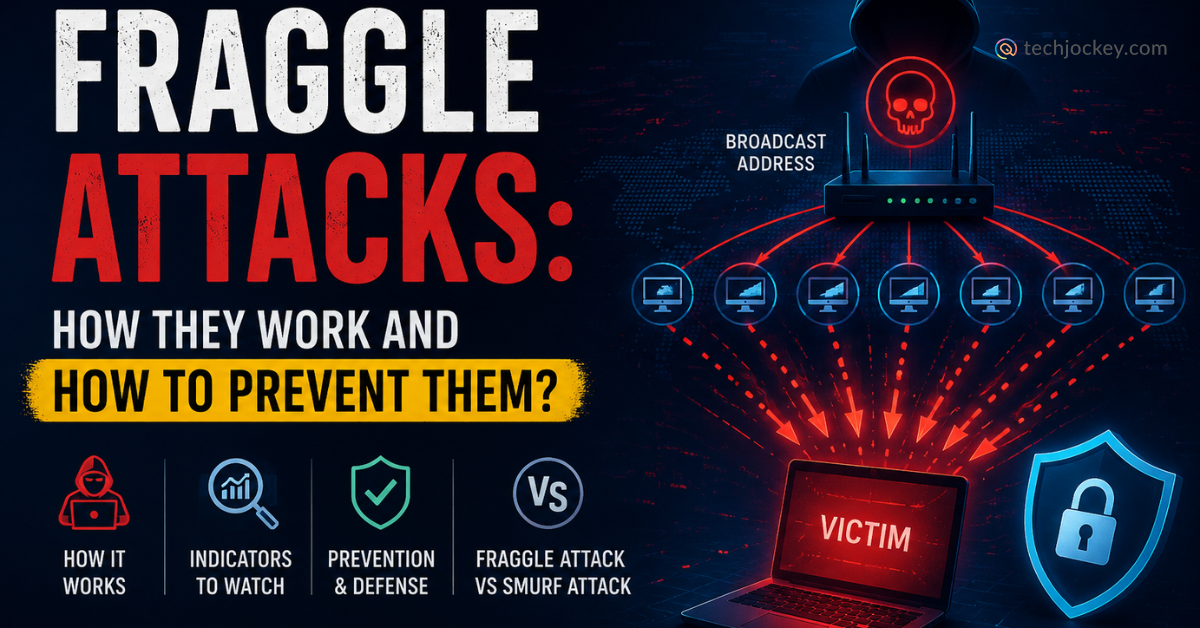
A Fraggle attack is a Distributed Denial-of-Attack (DDoS) that overwhelms a target network by filling it with a large volume of fake traffic. This initiates a process by sending User Datagram Protocol (UDP) packets to the broadcast address while spoofing the sender’s IP address to match the intended victims. When the network’s routers get the broadcast packets, they duplicate and send them to every device.
Fraggle attack is a cyberattack that creates challenges, and UDP enables quick communication between two systems. UDP helps companies that use voice over IP and don’t delay in the authentication process.
There are many key stages that hackers follow to target simple UDP services and respond automatically to requests like UDP port 19 (Character Generator) or UDP port 7 (Echo).
Identifying the Fraggle attack requires monitoring network anomalies, replies from multiple hosts, and system performance. Given below are the primary indicators of a fraggle attack in a network security.
Preventing the fraggle attacks is about fixing small gaps to avoid being an easy target. When misconfigured broadcast networks go unchecked, this creates amplification-based attacks to exploit vulnerabilities.
A fraggle attack is highly dangerous because it directly attacks the confidential information and steals the data. It has a direct network and system impact, forcing routers or firewalls to carry more data packets than their handling capacity.
This attack can go beyond a technical failure and lead to financial loss or productivity loss of staff, along with disrupting users’ trust. Moreover, persistent attacks can crash systems that respond to unwanted requests.
| Feature | Smurf Attack | Fraggle Attack |
|---|---|---|
| Protocol | ICMP (Internet Control Message Protocol) | UDP (User Datagram Protocol) |
| Common Service | ICMP Echo Requests (pings) | UDP Port 7 (Echo) or Port 19 (Chargen) |
| Traffic Type | Shows up as an ICMP flood | Shows up as an amplified UDP flood |
| Damage Potential | High, but limited to a single response per ping | Potentially higher due to infinite traffic loops |
A fraggle attack and a smurf attack are types of Distributed Denial-of-Service (DDoS) methods. While they both share identical goals and methods, they differ in the communications protocols they exploit. The key similarities include IP spoofing and exploiting the network’s broadcast to crash the server. A smurf attack depends on simple pings, but a fraggle creates a self- sustaining infinite traffic loop.
So, when it comes to taking defensive measures against smurf attacks, one should focus on filtering ICMP traffic and reconfiguring operating systems. On the other hand, fraggle attacks disable and isolate legacy UDP services. Moreover, the protection for both is to ensure that all routers and edge devices are disabled for IP-directed broadcasts.
Conclusion
Ultimately, Fraggle attacks are a reminder to strengthen business networks. While modern routers have made these attacks less prevalent by disabling broadcasts by default, they remain a threat to misconfigured infrastructure and legacy systems. Also, as cyber threats continue to evolve, proactive measures will always be necessary steps to secure your network.


Consult with Our Techjockey Expert
Connect for fast and scalable software delivery, corporation plans, advanced security, and much more.
Compare Popular Software
Is Shadow AI Putting Your Company at Risk? Find Out Now!
February 11, 2026

Adversarial Machine Learning: A Simple Guide for Businesses
February 11, 2026


Get the latest Techjockey US Blog Updates!
Subscribe to get the first notified about tech updates directly in your inbox.

 Previous