May 28, 2026

Ever wondered how the attacker can slip into your network without cracking your password?
Across the enterprise, setup devices recognize each other, and employees move between the systems, assuming that the framework is safe. But the same trust becomes vulnerable when ARP spoofing enters, and they blend into the system, pretending to be a trusted connection. This results in a session hijack and the interception of sensitive data.
Organizations often create a blind spot by only focusing on external threats and leaving the internal network less monitored. Also, the everyday users remain unaware that their data could be exposed by connecting to the same network.
Addressing the risks begins with control and visibility by using Cybersecurity Software to monitor unusual patterns and close gaps that ARP spoofing exploits. In this blog post, let’s understand the ARP protocol, how it works, and best practices for ARP spoofing prevention.
The Address Resolution Protocol (ARP) connects the Internet Protocol (IP) address to the media access control (MAC) address on a local network. It helps computers find the physical address they need to deliver data accurately within the same LAN. Simply, ARP tells who has a specific IP address. When a device sends traffic to another one on the local network, it first verifies its ARP table.
If no matching entry is found, the device sends an ARP request, and using that IP address, the host replies with its MAC address. ARP becomes essential as an IP address identifies devices at the network level, while Ethernet relies on MAC addresses.
ARP spoofing, also known as ARP poisoning or ARP cache poisoning, is a cyber-attack that is done by sending fake ARP messages that deceive devices on a local network. The victim accidentally associates the attacker’s MAC address with a legitimate IP address.
This attack method allows the attacker to block, alter, and intercept traffic between network devices, which causes serious security risks. Attackers gain access to your sensitive information, such as financial data, login credentials, and communications. Also, spoofing can corrupt data files and modify critical data information.
ARP Spoofing works to steal your business data, and an attacker follows a sequence to execute the attack. Knowing these steps beforehand will help you understand the attack process, and it will prepare you to take preventive measures.
The first step of ARP spoofing is to gain access to the local network via a shared Wi-Fi connection. This phase becomes helpful to the attacker to collect information by identifying targets, servers, or routers that contain sensitive information. By utilizing this information, the attackers stage an assault for a larger impact.
The attackers send unsolicited replies to the victims and make them believe that the IP is from a trusted source. Several automated tools are used to send these messages to redirect packets on a LAN.
This attack is effective in a framework where a weak network segmentation is present. This leads to obtaining session IDs, hijacking legitimate user accounts, and emails. This traffic mishandling allows an attacker to modify data without the user’s knowledge.
This is used to maintain a normal appearance in networks by linking the MAC address with the IP address of a legitimate device. This allows attackers to modify and spy on traffic intended for that device.
The methods below detect if the ARP cache has been through the poisoning attack. You can start an operating system shell and use the following command prompt to display the ARP table on both Linux and Windows.
Command Prompt
Open the command prompt first as an administrator. Then press the Windows Key to open the Start menu. Type cmd, then press Ctrl, Shift, and Enter. This will bring up the Command Prompt, then click yes to give the app permission and make changes.
Enter arp-a, it will give you the ARP table:
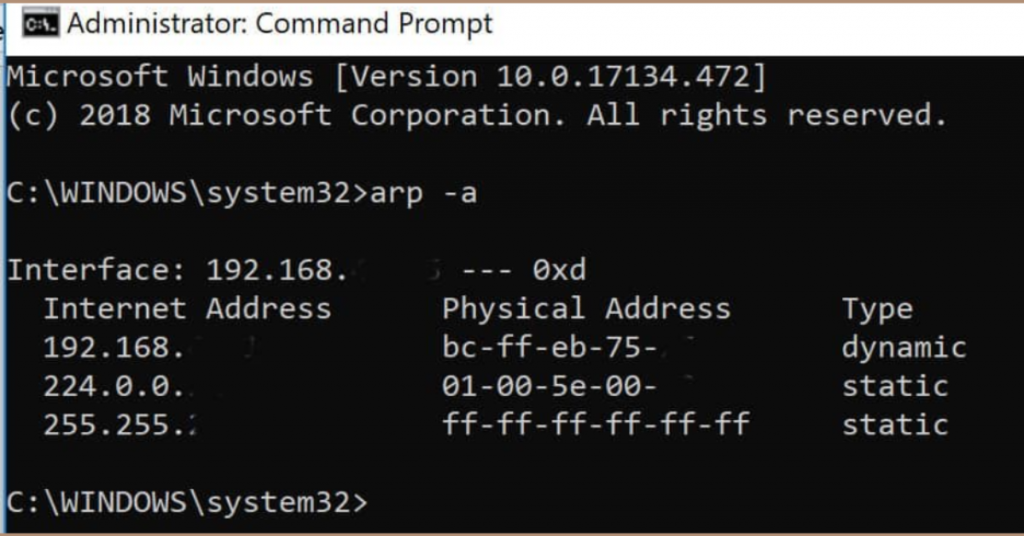
Now, understand the table above that contains two different IP addresses with similar MAC addresses, then you are probably undergoing an ARP poisoning attack.
Network Monitoring Tools
Using the network monitoring tool to detect unusual traffic patterns in network communication. Tools like ARPWatch or Wireshark monitor requests, provides alerts when ARP poisoning occurs to minimize damage.
It is crucial to take preventive measures to safeguard your network from ARP spoofing attacks. Listed below are the different approaches to explore.
Conclusion
APF spoofing has a major impact on your network security. Attackers take advantage of the trust built into your network protocols. From understanding how ARP spoofing works, identifying early signs, and implementing preventive measures, every step helps you to strengthen your defence mechanism.
If you want your infrastructure to handle sensitive data, now is the time to move from awareness to action and don’t get exposed to gaps. Evaluate your network security posture and implement the right solutions that align perfectly with your requirements.


Consult with Our Techjockey Expert
Connect for fast and scalable software delivery, corporation plans, advanced security, and much more.
Compare Popular Software
Is Shadow AI Putting Your Company at Risk? Find Out Now!
February 11, 2026

Adversarial Machine Learning: A Simple Guide for Businesses
February 11, 2026


Get the latest Techjockey US Blog Updates!
Subscribe to get the first notified about tech updates directly in your inbox.

 Previous