AI tools like ChatGPT, Gemini, and Claude are becoming a part of everyday business operations. Companies are using them for content creation, coding assistance, research, customer support, and more. But building an AI model is only one part of the process. The real challenge is deploying it and further manage it to keep it reliable over time.
This is exactly where LLMOps, short for Large Language Model Operations, comes in. If you are wondering what is LLMOps, you have landed in the right place.
For those completely unversed, however, LLMOps act as a framework that helps teams manage large language models throughout their entire lifecycle. This, so they work efficiently always. Let’s deduce how…
LLMOps (Large Language Model Operations) is the set of practices, tools, and processes used to develop, deploy, monitor, and maintain large language models in real-world environments. This basically helps organizations manage AI models after they are built and put into use.
If you are still confused as to what is LLMOps, think of it as a car. Now, building the car is important but let’s not forget that it would need fuel, repairs, and regular checkups to keep running properly. LLMOps does the same for large language models.
As a result, it covers tasks such as data preparation, model fine-tuning, prompt management, testing and evaluation, deployment, performance monitoring, security and compliance etc.
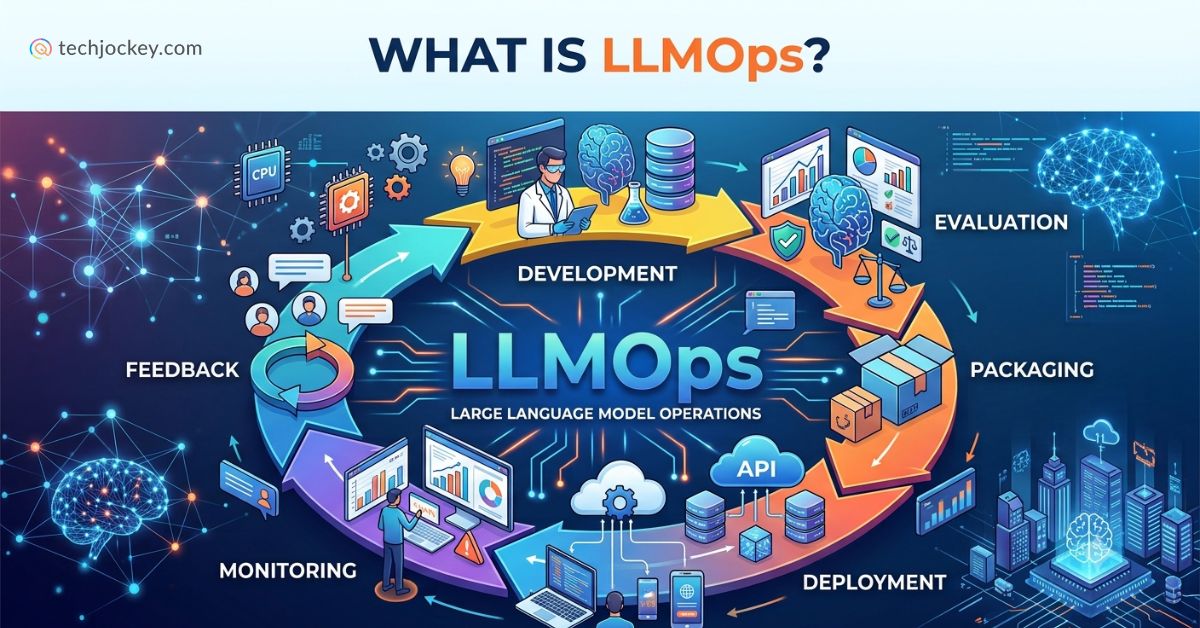
The LLMOps lifecycle begins with data collection and preparation. Teams gather relevant data, remove errors, and prepare it for model training or fine-tuning. High-quality data is important because it directly affects the quality of the model’s responses.
After the data is ready, the model is trained to perform specific tasks and meet business requirements. Once training is complete, the model goes through testing and evaluation. Teams check response accuracy, safety, relevance, and overall performance before releasing it to users.
After successful testing, the model is deployed into applications such as chatbots, virtual assistants, or business platforms. The work does not stop after deployment. Teams continuously monitor the model to track performance, identify issues, and improve outputs. Regular optimization and maintenance make certain the model remains aligned with changing business needs.
LLMOps offers several advantages that help organizations get the most out of their large language models…
While LLMOps offers many advantages as listed above, it also comes with a few challenges that organizations should consider. These include…
LLMOps is widely used anywhere large language models are deployed in real-world environments. One of the most common use cases is customer support, where businesses use AI chatbots to answer customer questions, resolve issues, and provide assistance around the clock. LLMOps helps keep these systems accurate and responsive.
It is also used in content creation, enabling organizations to generate articles, emails, product descriptions, and marketing content while ensuring quality through and through.
Another important use case is virtual assistants and knowledge management systems. Companies use AI-powered assistants to help employees find information, summarize documents, and improve productivity.
Software development teams also use LLMs for code generation and debugging, making development faster. In industries such as healthcare, finance, and legal services, LLMOps helps organizations deploy AI solutions while maintaining performance, compliance, and data security.
By managing the entire lifecycle of large language models, LLMOps, as such, helps businesses use AI applications in the best way possible.
LLMOps platforms are machine learning software solutions designed to help developers build, operate, and manage large language model applications like ChatGPT and more. As part of the process, these help teams manage prompts, track model performance, monitor costs, ensure security, and maintain compliance requirements.
These also ensure AI responses stay relevant and accurate through and through. LLMOps platforms basically act as the control center for AI applications, so everything artificial intelligence stays in check and yields the best of returns.
LLMOps platforms offer a range of functionalities to help businesses better optimize their AI applications. Some of them include…
Conclusion
LLMOps turns large language models from simple AI tools into valuable business solutions. As organizations continue adopting generative AI, LLMOps helps bridge the gap between building an AI model and delivering real value from it.
If you wish to know what sets LLMOps apart from MLOps, read our blog on LLMOps vs MLOps and put all your queries to rest!
Educational institutions struggle every day with scattered applicant inquiries across digital channels. Delayed counselor responses… Read More
Real estate site tour management often poses significant operational challenge! This rings especially true… Read More
Keeping employees safe is not just legal requirement. It is also essential for smooth… Read More
Building software requires time, efforts, and money in equal measure. But if the same software… Read More
If AI tools have become part of your daily work, chances are you already… Read More
Every business needs data to run efficiently. Developers need it to test applications. Analysts need… Read More
