March 3, 2026
Key Takeaways
Let’s unpack this step by step.
A PEO works on a co-employment structure, which means that it’s your HR partner that helps you manage HR-based tasks without taking away your control. Although PEO handles your tasks like payroll, tax filings, employee benefits, etc., you still remain the main legal employer.
PEOs are a well-suited option for US-registered businesses that have limited internal bandwidth to manage tasks. They give you access to better employee benefits (often at lower group rates), help you with changing labor laws, and take a lot of administrative work off your plate.
It is to be noted that a PEO does not hire employees for you. In simple, words, if you want to directly manage your workforce, offer better employee benefits, and simplify compliance, this model can help without requiring a bigger in-house HR team.
An EOR works a bit differently. In this model, the EOR becomes the legal employer of your workers and helps you hire outside your state or overseas, where you don’t have a registered business.
It’s a smart choice for US companies wanting to expand internationally. It’s beneficial as it is the only one that deals with complex registrations and local labor laws, removing your burden of creating a new entity in a new place.
An EOR handles all tasks from payroll to taxes, benefits to compliance requirements, and more. However, you manage your team’s daily work, goals, and performance, but on paper, the EOR is the official employer. Many leading EOR providers already have networks across different states and countries, which makes hiring and onboarding talent much smoother.
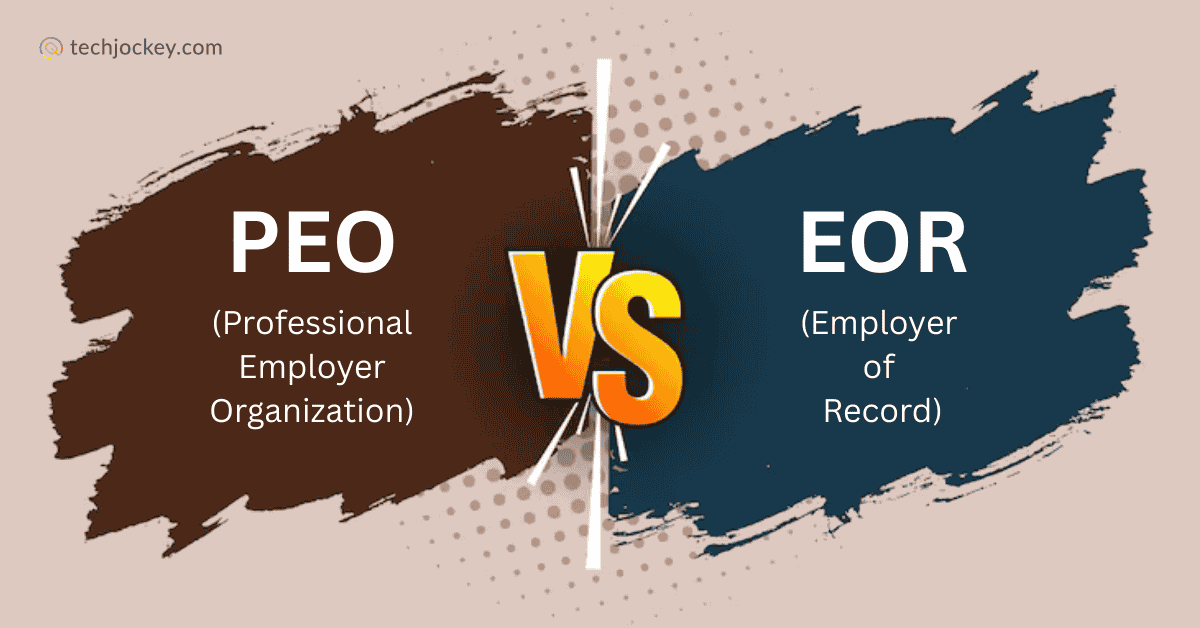
Both PEOs and EORs help you with HR tasks, but the main difference between PEO and EOR is all about the legal responsibility and control. With a PEO, you are the legal employer, but PEOs help you with shared responsibilities. On the other hand, in the EOR case, EOR is the full legal employer on your behalf.
However, in PEO, you need to have a registered business where you are hiring a workforce, but when working with EOR, you can hire an international workforce without having a registered entity in the state or country. Their pricing models, employee benefits, and compliance are different too.
Let’s have a look at the detailed description of the key differences.
| Basis | PEO (Co-Employment) | EOR (Full Employment) |
|---|---|---|
| Who is the legal employer? | Your company | The EOR |
| Who manages employees? | You manage daily work; PEO handles HR tasks like payroll and benefits. | You manage daily work; EOR handles contracts, payroll, and taxes. |
| Compliance & legal risk | Responsibility is shared, but you carry most of the risk. | EOR takes most of the compliance and legal risk. |
| How they charge | Percentage of payroll or monthly fee per employee. | Fixed monthly fee per employee. |
| Employee benefits | Access to large-group US insurance plans. | Provides legally required benefits, especially for multi-state or global hiring. |
The biggest difference between PEO and EOR comes down to who the legal employer is.
With a PEO, you enter into a co-employment setup. That means you’re still the legal employer and remain responsible for major decisions and certain liabilities.
The PEO helps by handling payroll, benefits, and compliance administration. You stay in control of your team, while the PEO takes a large portion of HR work off your plate.
An EOR works differently. In this model, the EOR becomes the legal employer of your workers. You still manage daily tasks, performance, and operations, but the EOR holds the employment contracts, runs payroll, manages taxes, and ensures compliance.
This setup shifts most of the legal and financial risk away from your company, which can be especially helpful when expanding into new states or countries.
In the US, employment laws vary not just at the federal level but also from state to state. A PEO helps you understand and manage these rules, but your company still shares liability. If you’re hiring across multiple states, things like payroll taxes, unemployment insurance, and workers’ compensation can get complicated, and you’re still ultimately responsible for staying compliant.
On the other hand, EOR takes on most of that compliance responsibility. If you’re hiring in different states or internationally, the EOR ensures contracts, tax filings, and benefits meet local legal requirements. This greatly reduces your risk, especially in locations where labor laws are strict, and mistakes can lead to fines or legal issues.
PEOs typically charge either a percentage of your total payroll, often between 2% and 12%, or a flat monthly fee per employee. While this sounds simple, costs can increase as your payroll grows. There may also be extra administrative fees for certain services.
EORs usually charge a fixed monthly fee per employee. This often includes payroll processing, tax management, and required benefits. The pricing is generally predictable, which helps when budgeting for multi-state or international hiring.
However, at first glance, EOR fees may seem higher, especially if you already have a US entity and primarily hire domestically.
Employee benefits are another key difference.
With a PEO, US businesses can often access large-group insurance plans and stronger benefits packages. This can make it easier to attract and retain talent. However, eligibility depends on the co-employment structure and state rules.
EORs focus more on meeting legal benefit requirements, particularly for international hires. They manage mandatory health coverage, retirement contributions, and other required benefits based on local laws. While the benefit packages may not always be as premium as large-group PEO plans, they ensure your business stays compliant and avoids penalties.
While making a choice between a PEO and EOR, you must consider your business setup and how you plan to grow.
If your business is already registered under US laws, and you want strong employee benefits, want to be their boss while outsourcing HR admin work, you must go for a PEO.
On the other hand, if you are planning to hire candidates from new states or outside your country, or reduce your employment liability, you should prefer EOR.
However, it is to be noted that you are not bound to one model forever. Many companies use a PEO for domestic operations and switch to an EOR when expanding into new markets. Others start with an EOR to test new regions and later establish their own entity, eventually transitioning to a PEO once their domestic workforce grows.
A PEO can give you access to strong employee benefits like group health insurance and retirement plans. It also helps you manage HR tasks and compliance requirements while allowing you to maintain day-to-day control over your workforce. This makes PEOs especially attractive for small to mid-sized US businesses.
However, because of the co-employment structure, you still share liability. That means your company can remain exposed to risks like wrongful termination claims or payroll mistakes. Plus, PEOs only work where you already have a registered entity, which can make multi-state or international expansion more complicated.
An EOR, in contrast, takes on most of the employment liability by becoming the legal employer. This significantly reduces your compliance burden and makes hiring across states or countries much simpler, without needing to set up a local entity.
The downside? EOR services can be more expensive per employee, and benefits are often focused on meeting legal requirements rather than offering premium-level plans.
Conclusion
At the end of the day, choosing between a PEO and an EOR comes down to where your business stands today, and where you want it to go.
If you already have a US entity and want HR support while staying in control, a PEO can help you manage compliance, reduce admin work, and offer strong benefits to your team.
If you’re planning to hire across state lines or expand internationally without setting up new entities, an EOR gives you the flexibility to grow faster while reducing legal risk.
Small US businesses with an existing legal entity often benefit from a PEO, as it allows access to better benefits and shared HR management. EORs are better for companies looking to hire across states or globally without establishing entities.
While a PEO reduces administrative burden, your company still shares legal liability. Multi-state hiring can be complex, and costs may increase as payroll grows.
No. A PEO operates under a co-employment model with shared responsibilities, whereas an EOR becomes the full legal employer, taking on most compliance and liability responsibilities.


Explore Topics

Consult with Our Techjockey Expert
Connect for fast and scalable software delivery, corporation plans, advanced security, and much more.
Compare Popular Software

Get the latest Techjockey US Blog Updates!
Subscribe to get the first notified about tech updates directly in your inbox.

 Previous