7 Best Data Masking Tools to Protect Sensitive Data in 2026


Every business needs data to run efficiently. Developers need it to test applications. Analysts need it to generate insights. Teams need it to make better decisions. The problem is that this data often contains sensitive information that should not be shared freely.
This is why many organizations use data masking tools. These solutions, as the name suggests, hide confidential details while keeping the data useful. ‘How?’ You ask. Let’s sought to answer and while at it, also look at the leading data masking software options available in the market. This, so your datasets stay secure, come what may.
What are Data Masking Tools?
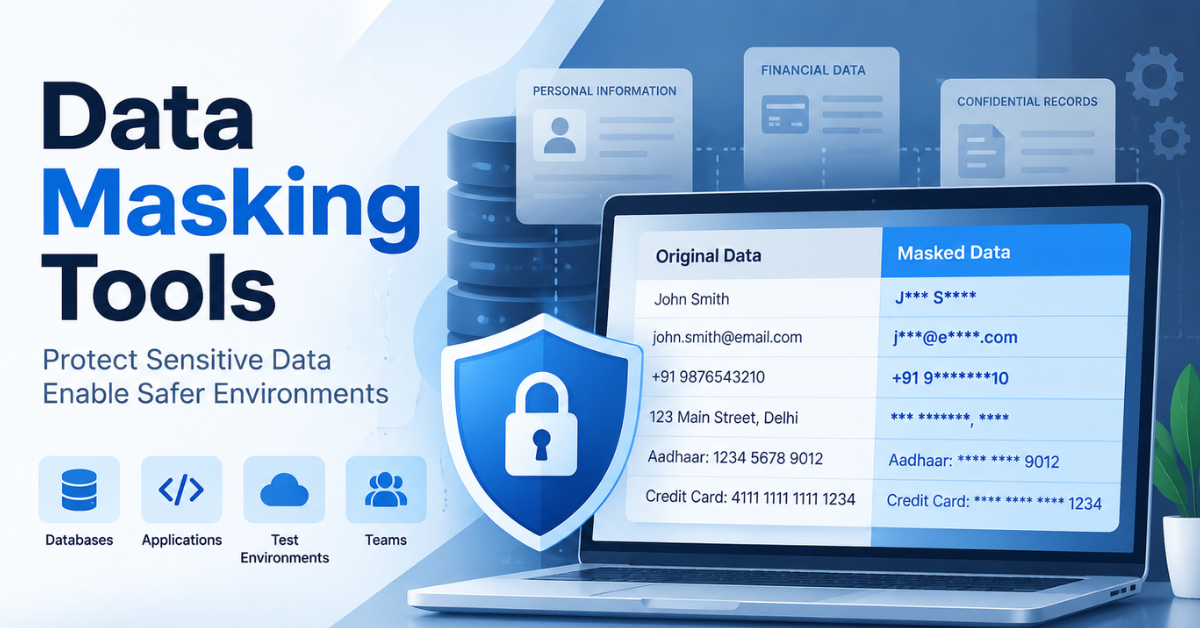
Data masking tools are data security software solutions that help protect sensitive information by replacing it with realistic but fictitious data. Instead of displaying actual customer names, email addresses, financial details, or personal records, these tools mask the original values while keeping the data format intact.
This allows developers, testers, analysts, and other teams to work with data safely without exposing confidential information. Many data masking software solutions also support compliance requirements and reduce the risk of data leaks. As a result, these tools are often considered essential for businesses that handle large volumes of sensitive information.
List of 7 Best Data Masking Tools in 2026
Choosing the right data masking tool can make a big difference in how securely your organization handles sensitive information. Below listed are 7 leading solutions that help protect confidential data while keeping it useful through and through…
| Tool | Best For | Standout Strength |
|---|---|---|
| Oracle Data Masking and Subsetting | Oracle database users | Combines data discovery, masking, and subsetting to create secure test datasets |
| Perforce Delphix | DevOps and testing teams | Automates sensitive data discovery and delivers masked data quickly across environments |
| K2view | Large enterprises with complex data ecosystems | Masks data consistently across multiple systems while preserving business context |
| IBM Optim Data Privacy | Compliance-focused organizations | Offers context-aware masking and format-preserving protection for enterprise data |
| DATPROF Privacy | Test data management teams | Combines data masking with synthetic data generation for realistic testing environments |
| Microsoft Azure Dynamic Data Masking | Azure SQL users | Masks sensitive fields in real time based on user access permissions |
| Tonic.ai | Software and AI development teams | Generates safe, production-like datasets using masking and synthetic data techniques |
Now, let’s take an in-depth look at these tools one by one…
1. Oracle Data Masking and Subsetting
Oracle Data Masking and Subsetting is a data protection solution designed for organizations that rely heavily on Oracle databases. It helps teams discover sensitive information, mask confidential records, and create smaller copies of production databases for testing and development.
One of its biggest strengths is maintaining data relationships and formats after masking, which allows applications to function normally while reducing the risk of exposing real customer or business data.
Key Features of Oracle Data Masking and Subsetting:
- Protects sensitive information through advanced masking techniques
- Discovers and classifies sensitive data automatically
- Preserves referential integrity across related records
- Creates smaller datasets using intelligent data subsetting
- Supports application data modeling for relationship mapping
- Identifies sensitive fields using built-in discovery patterns
- Enables multi-factor subsetting for realistic test datasets
- Provides in-database and in-export masking options
- Includes templates for Oracle E-Business Suite environments
- Supports Oracle Fusion Applications data protection
- Facilitates secure provisioning for test and development teams
- Supports heterogeneous database masking through Oracle Database Gateways
Pro and Cons of Oracle Data Masking and Subsetting:
Pros
- Reduces exposure of sensitive data in non production environments
- Improves compliance with privacy and regulatory requirements
- Preserves realistic data for testing and analytics
- Accelerates secure data provisioning processes
- Minimizes storage and infrastructure costs through subsetting
- Simplifies discovery of sensitive information across databases
- Maintains application functionality after masking operations
- Supports enterprise-scale database environments
Cons
- Requires Oracle expertise for deployment and administration
- Involves separate licensing beyond the core database platform
- Demands configuration effort for complex database ecosystems
- Targets enterprise use cases more than smaller organizations
- Requires ongoing governance to manage masking policies effectively
Oracle Data Masking and Subsetting Pricing & Plans: Price on request
2. Perforce Delphix
Perforce Delphix is an enterprise-grade platform that combines data masking with test data management. It automatically finds sensitive information across different data sources and replaces it with realistic values.
The platform is particularly useful for DevOps teams because it speeds up the delivery of secure test data while maintaining consistency across databases, data warehouses, and data pipelines. This helps organizations balance security and development efficiency.
Key Features of Perforce Delphix:
- Delivers automated sensitive data discovery across databases, warehouses, and pipelines
- Provides enterprise-scale data masking for compliance initiatives
- Preserves referential integrity across masked datasets
- Supports AI-driven masking of sensitive information
- Enables no-code and low-code policy creation
- Offers customizable masking algorithms for unique use cases
- Integrates masking with data virtualization workflows
- Applies centralized policy enforcement across environments
- Supports compliant data delivery for development and testing teams
- Provides auditability and governance for nonproduction data
- Protects data across on-premises, cloud, and hybrid infrastructures
- Enables consistent masking across sources, pipelines, and clouds
Pro and Cons of Perforce Delphix:
Pros
- Reduces compliance risks through automated data protection
- Accelerates delivery of production-like test data
- Preserves data usability after masking operations
- Simplifies enterprise-wide policy management
- Supports GDPR, HIPAA, PCI DSS, and other compliance requirements
- Improves developer productivity with faster data access
- Scales effectively across large and complex environments
- Combines masking and virtualization in a single platform
Cons
- Requires implementation planning for enterprise deployments
- Demands governance policies for maximum effectiveness
- Involves custom sizing based on managed data volumes
- Presents a learning curve for first-time users
Perforce Delphix Pricing & Plans: Price on request
3. K2view
K2view is a data masking platform built for large and complex enterprise environments. Instead of masking individual databases separately, it organizes and protects data around business entities such as customers or accounts.
This approach ensures consistent masking across multiple systems while preserving context and relationships. It is especially useful for organizations that manage sensitive information spread across different applications, databases, and cloud environments.
Key Features of K2view:
- Enables data masking across structured and unstructured data sources
- Discovers and classifies sensitive data automatically
- Preserves referential integrity across systems and datasets
- Supports masking of data in motion and at rest
- Simplifies policy management through centralized masking rules
- Organizes data around business entities for consistent protection
- Provides static and dynamic data masking capabilities
- Supports pseudonymization and tokenization for controlled access
- Generates compliance-ready reports for audits and regulations
- Delivers production-like datasets for testing and analytics
- Enables custom and built-in masking algorithms
- Automates sensitive data governance across environments
Pro and Cons of K2view:
Pros
- Protects data while preserving business context and relationships
- Simplifies complex masking projects through an entity-based approach
- Improves compliance with privacy regulations and standards
- Supports both real-time and batch masking scenarios
- Reduces manual effort through automated discovery and classification
- Delivers consistent masking across multiple data sources
- Handles large enterprise datasets at scale
- Combines data integration and masking within a unified platform
Cons
- Requires implementation planning for large deployments
- Focuses primarily on enterprise-scale use cases
- Involves a learning curve for new users
- May provide more functionality than smaller teams require
K2view Pricing & Plans: Price on request
4. IBM Optim Data Privacy
IBM Optim Data Privacy helps organizations protect sensitive information across databases, applications, and operating systems. The platform focuses on context-aware masking, which means masked data remains realistic and usable for testing and analytics.
It also supports format-preserving protection and consistent masking across different environments. These capabilities make it a strong option for businesses with strict privacy and regulatory compliance requirements.
Key Features of IBM Optim Data Privacy:
- Protects sensitive data using advanced masking techniques across databases, applications, and systems
- Preserves business context and relational integrity after masking
- Supports test data management and secure nonproduction environments
- Automates sensitive data governance with predefined privacy rules
- Includes more than 30 predefined data classifications
- Provides over 40 predefined data privacy rules
- Enables data subsetting for right-sized test datasets
- Supports format-preserving masking and data transformations
- Integrates with governance tools for policy-based masking workflows
- Delivers production-like data for development and testing teams
- Handles heterogeneous environments across databases and platforms
- Automates data comparisons and validation processes
Pro and Cons of IBM Optim Data Privacy:
Pros
- Reduces privacy risks in nonproduction environments
- Preserves realistic data for accurate software testing
- Supports compliance with GDPR, HIPAA, GLBA, and similar regulations
- Simplifies management of complex enterprise datasets
- Improves testing efficiency through automated data provisioning
- Supports legacy, mainframe, and modern database environments
- Scales effectively for large enterprise deployments
- Integrates well with broader IBM data management solutions
Cons
- Requires specialized expertise for deployment and administration
- Presents a steeper learning curve than simpler masking tools
- Focuses primarily on enterprise-scale environments
- Requires implementation planning across complex data ecosystems.
IBM Optim Data Privacy Pricing & Plans: Price on request
5. DATPROF
DATPROF Privacy is a data masking and synthetic data generation solution aimed at software development and testing teams. It allows users to anonymize sensitive information while preserving important data characteristics needed for realistic testing.
The platform supports consistent masking across multiple databases and applications, helping organizations maintain data quality while meeting privacy requirements. Its focus on test data management makes it popular among QA and development teams.
Key Features of DATPROF:
- Enables data masking and synthetic data generation in one platform
- Protects sensitive data for development and testing environments
- Preserves data characteristics for realistic test scenarios
- Supports consistent masking across multiple databases and applications
- Provides deterministic masking to maintain data relationships
- Generates synthetic data using 50+ built-in generators
- Applies conditional masking based on specific business rules
- Delivers high-performance masking directly within databases
- Supports custom scripts, expressions, and masking logic
- Integrates masking workflows into CI/CD pipelines
- Automates deployment and monitoring through DATPROF Runtime
- Supports data subsetting for smaller, more efficient test datasets
Pro and Cons of DATPROF:
Pros
- Simplifies test data management through an intuitive interface
- Improves compliance with GDPR, PCI DSS, and HIPAA requirements
- Preserves production-like data quality after masking
- Accelerates test data provisioning and refresh cycles
- Supports automation for modern DevOps workflows
- Handles large databases through parallel processing
- Combines masking, subsetting, and synthetic data generation in one solution
- Reduces manual effort through reusable masking templates
Cons
- Focuses mainly on test data management use cases
- Requires planning for complex enterprise implementations
- Offers fewer enterprise governance capabilities than some larger platforms
- May require customization for highly specialized masking needs
DATPROF Pricing & Plans: Price on request
6. Microsoft Azure Dynamic Data Masking
Microsoft Azure Dynamic Data Masking is a built-in feature for Azure SQL services that helps limit access to sensitive information. Rather than changing the actual data, it masks selected fields when viewed by unauthorized users.
This makes it a practical choice for organizations that want an additional layer of protection without altering database records. It is commonly used to control data exposure in cloud-based SQL environments.
Key Features of Microsoft Azure Dynamic Data Masking:
- Protects sensitive information by masking query results for nonprivileged users
- Prevents unnecessary exposure of confidential data without changing stored values
- Supports policy-based data protection with minimal application impact
- Enables column-level masking through configurable masking rules
- Provides built-in masking functions for common use cases
- Includes email masking for partial email visibility
- Supports custom string masking for flexible protection
- Delivers random masking for numeric data fields
- Allows privileged users to access unmasked data when required
- Integrates directly through the Azure portal, T-SQL, PowerShell, and APIs
- Provides masking recommendations for sensitive database columns
- Supports compliance-driven access control initiatives
Pro and Cons of Microsoft Azure Dynamic Data Masking:
Pros
- Reduces exposure of sensitive information to unauthorized users
- Requires minimal application changes during deployment
- Simplifies implementation through built-in Azure tools
- Preserves original data while masking query outputs
- Supports granular control over who can view unmasked data
- Improves compliance for production and nonproduction workloads
- Automates protection for commonly sensitive data types
Cons
- Provides masking rather than true encryption
- Remains dependent on underlying database permissions
- Focuses on query-result protection instead of data transformation
- Requires additional security controls for stronger protection needs
- Offers fewer advanced masking workflows than dedicated data masking platforms
Microsoft Azure Dynamic Data Masking Pricing & Plans: Microsoft Azure Dynamic Data Masking is included with Azure SQL services.
7. Tonic.ai
Tonic.ai is a modern data masking platform designed for software development, testing, analytics, and AI projects. It automatically identifies sensitive data and transforms it into safe, production-like datasets.
The platform is known for combining data masking, synthetic data generation, and database subsetting in a single solution. By maintaining data structure and relationships, it enables teams to work with realistic datasets without exposing private info.
Key Features of Tonic.ai:
- Delivers high-fidelity synthetic data for software and AI development
- Generates realistic relational databases from scratch
- De-identifies structured and semi-structured production data
- Redacts and synthesizes unstructured text, documents, and files
- Preserves referential integrity across datasets
- Supports data subsetting for faster testing workflows
- Creates mock APIs for development and QA environments
- Enables AI model training with privacy-safe datasets
- Provides automated data generation through AI-powered agents
- Supports structured, semi-structured, and unstructured data sources
- Integrates with CI/CD and cloud-native development workflows
- Helps meet privacy requirements while maintaining data usability
Pro and Cons of Tonic.ai:
Pros
- Accelerates development with instantly available synthetic data
- Reduces privacy risks by replacing sensitive production data
- Preserves realistic data relationships for accurate testing
- Supports both software development and AI initiatives
- Simplifies handling of structured and unstructured datasets
- Improves testing quality with production-like data
- Integrates smoothly with modern engineering workflows
- Scales across enterprise data environments
Cons
- Requires vendor consultation for advanced enterprise deployments
- Presents a learning curve for teams new to synthetic data
- Focuses heavily on data synthesis rather than traditional masking alone
- May exceed the needs of smaller organizations with simple masking requirements
- Involves consumption-based costs for large-scale data generation workloads
Tonic.ai Pricing & Plans:
| Plan | Price |
|---|---|
| Free | USD 0/month |
| Plus | USD 29/month |
| Enterprise | Price on request |
Conclusion
The right data masking tool can help you protect sensitive data without making it difficult for teams to do their work. The key is to choose one that fits your security goals and day-to-day requirements in the best way possible. If you have made up your mind already, know that the Techjockey team is just a call away!


Written by
Techjockey Team

The Techjockey content team is a passionate group of writers and editors dedicated to helping businesses make informed software buying decisions. We have a deep understanding of the Indian software market and the challenges that businesses face when choosing the right software for their needs. We are committed... Read more
 Previous