AI projects do not end when a model is built. Teams must deploy it, monitor its performance, fix issues if there are any, and keep it running smoothly over time. That is where operational practices like MLOps and LLMOps become important.
And that is exactly why, as businesses adopt generative AI alongside traditional machine learning, understanding LLMOps vs MLOps is essential. While both approaches help manage AI
systems in production, they are designed for different types of models and challenges. ‘How?’ You ask. Keep reading to get an answer…
LLMOps stands for Large Language Model Operations. It is the process of managing, deploying, and maintaining large language models (LLMs) like ChatGPT, Gemini, and Llama.
LLMOps basically act as the system that keeps AI applications running smoothly after they are built. It helps teams deploy AI models, monitor their performance, improve response quality,
and fix issues if and when they occur.
LLMOps also helps manage prompts, control costs, protect sensitive data, and ensure AI outputs remain accurate. As users interact with an AI application, LLMOps enables teams to track performance and make continuous improvements.
Businesses use LLMOps for AI chatbots, virtual assistants, content generation tools, customer support systems, and other AI tools.
MLOps stands for Machine Learning Operations. It is a set of practices that helps teams build, deploy, manage, and improve machine learning models.
In layman’s terms, it is a system that keeps AI models running smoothly after they are developed. It brings together data science, software development, and IT operations into one process.
Without MLOps, managing machine learning models can become slow and difficult. They may stop performing well as data changes over time. MLOps address the issue by helping teams monitor performance, update models when needed, and fix issues quickly.
For example, a bank may use a machine learning model to detect fraud. MLOps helps deploy that model, track its accuracy, and retrain it when new fraud patterns appear. The main goal of MLOps basically is to make machine learning projects easier to maintain.
Suggested Read: What Is an MLOps Platform? Features, Benefits & Top 5 Platforms
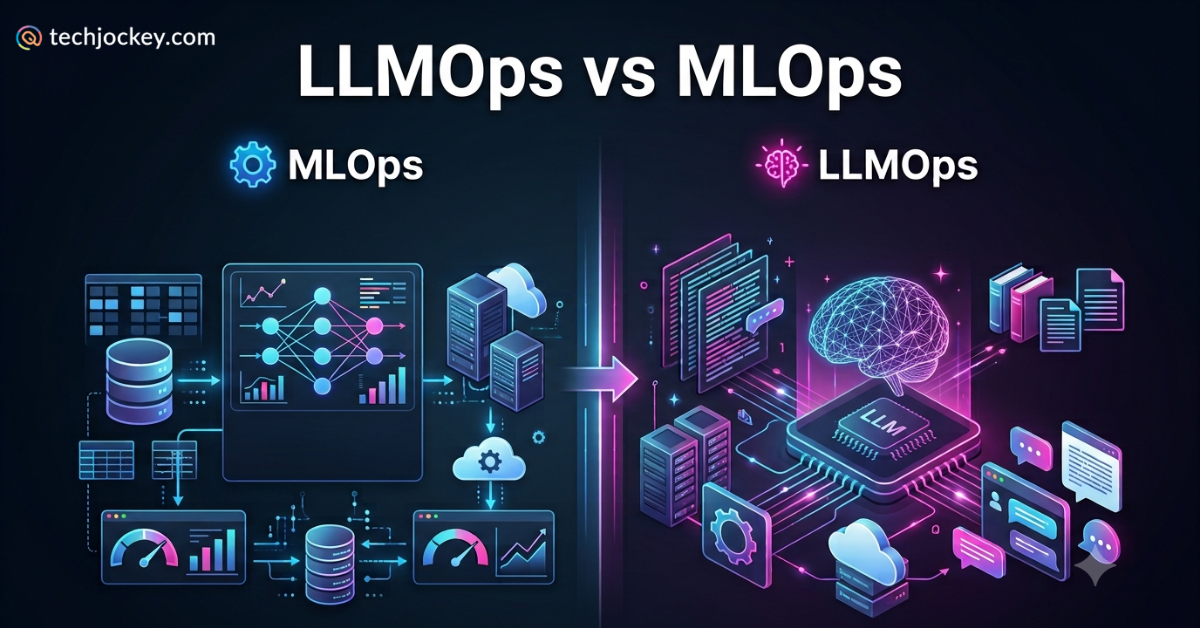
MLOps and LLMOps both help teams deploy and manage AI systems. However, their workflows, tools, and focus areas are quite different. Let’s understand how…
| Comparison | MLOps | LLMOps |
|---|---|---|
| Definition | Manages machine learning models in production | Manages large language models in production |
| Primary Focus | Model training, deployment, and monitoring | LLM deployment, evaluation, and optimization |
| Models | Traditional ML models | Large language and foundation models |
| Development | Training and feature engineering | Prompt engineering, fine-tuning, and RAG |
| Data | Structured and labeled datasets | Text, documents, and unstructured data |
| Output | Predictions, classifications, and scores | Text, answers, summaries, and generated content |
| Evaluation | Accuracy, precision, recall, and error rate | Relevance, factuality, consistency, and safety |
| Monitoring | Model performance and data drift | Hallucinations, response quality, latency, and cost |
| Best Use Cases | Fraud detection, forecasting, and recommendations | Chatbots, AI assistants, content generation, and summarization |
MLOps helps teams manage machine learning models that make predictions from data. For example, it can predict customer churn, detect fraud, or forecast sales.
LLMOps, on the contrary, helps teams manage large language models that generate text, answer questions, and interact with users. Its goal is to deliver accurate, useful, and safe
responses at scale.
In MLOps, teams usually collect data, train a model, test it, and deploy it into production. In LLMOps, contrarily, teams often start with a pre-trained language model and customize it using prompts, fine-tuning, or external knowledge sources. This makes the development process quite different.
MLOps mainly depends on structured data, such as numbers, tables, and database records.
LLMOps, on the other hand, relies heavily on text-based information, including documents, websites, emails, and knowledge bases. Managing this unstructured data is a key part of LLMOps.
In MLOps, improving model performance often requires feature engineering, where data is carefully prepared before training.
In LLMOps, prompt engineering is equally important. The instructions given to a language model can significantly affect the quality and accuracy of its responses.
MLOps models are usually measured using metrics like accuracy, precision, recall, and prediction error. LLMOps, on the flip side, focuses on response quality. Teams evaluate whether answers are relevant, factual, and aligned with user expectations.
After deployment, MLOps teams monitor model accuracy and watch for issues such as data drift. LLMOps teams, on the other hand, go beyond this to monitor additional factors, including hallucinations, response consistency, prompt performance, and user feedback. This requires a broader monitoring approach.
MLOps deployments usually focus on deploying and managing a trained machine learning model. In contrast, LLMOps deployments are often more complex because they involve multiple moving parts, including large language models (LLMs), prompts, vector databases, retrieval systems, and safety mechanisms.
All these components must work together seamlessly to deliver accurate, reliable, and secure AI responses.
MLOps primarily focuses on model stability, performance, and regulatory compliance. LLMOps must address those same concerns while also managing the risks that come with AI-generated content, such as hallucinations, bias, privacy issues, and unsafe responses. This makes governance and safety controls a much larger part of the LLMOps workflow.
Suggested Read: SLM vs LLM: Key Differences, Benefits & Use Cases
The choice between LLMOps and MLOps depends on the type of AI solution you want to build. If your goal is to create models that analyze data and make predictions, MLOps is usually the better option.
It is commonly used for applications such as fraud detection, demand forecasting, customer churn prediction, and recommendation systems. MLOps helps teams manage the entire lifecycle of these machine learning models, from development and deployment to monitoring and maintenance.
On the other hand, if your application uses large language models to generate content, answer questions, summarize information, or interact with users, LLMOps is the better fit. It is designed to handle the unique requirements of generative AI, including prompt management, model evaluation, AI safety, and response monitoring.
In many organizations, it is not a matter of LLMOps vs MLOps. Instead, both approaches work together. Businesses often use MLOps for predictive analytics and LLMOps for AI-powered assistants, chatbots, and content generation tools. Choosing the right approach thus depends on the type of AI experience you wish to deliver.
Conclusion
Understanding LLMOps vs MLOps is important for organizations adopting AI. Both follow similar principles but address different challenges. So, as you go ahead and choose one, make sure you make the right choice, because building effective AI solutions is the goal and to achieve that, this choice matters the most!
Organizations should adopt LLMOps when building AI applications powered by LLMs, such as chatbots, copilots, content generation tools, or question-answering systems.
MLOps focuses on managing traditional machine learning models used for predictive tasks, while LLMOps is designed specifically for large language models and generative AI applications, including prompt management, response monitoring, and AI safety
Yes. Many organizations use MLOps to manage predictive models and LLMOps to operate generative AI systems. Together, they help businesses manage a broader range of AI applications.
LLMOps helps address challenges such as prompt optimization, hallucination detection, response quality evaluation, AI governance, latency management, and inference cost control
A scattered set of security applications makes remote team management way harder than it must… Read More
Even after spending massive budgets to generate leads, real estate developers routinely lose top-tier buyers… Read More
In the recent past, everyday hotel operations depended almost completely on paper logbooks, whiteboards, and… Read More
For education counselors, the push to turn student curiosity or interest into confirmed enrollment is… Read More
Running startup isn't just about building a product and finding the right customers for… Read More
Cyber threats are changing fast. Attackers are finding new ways to get into systems without… Read More
