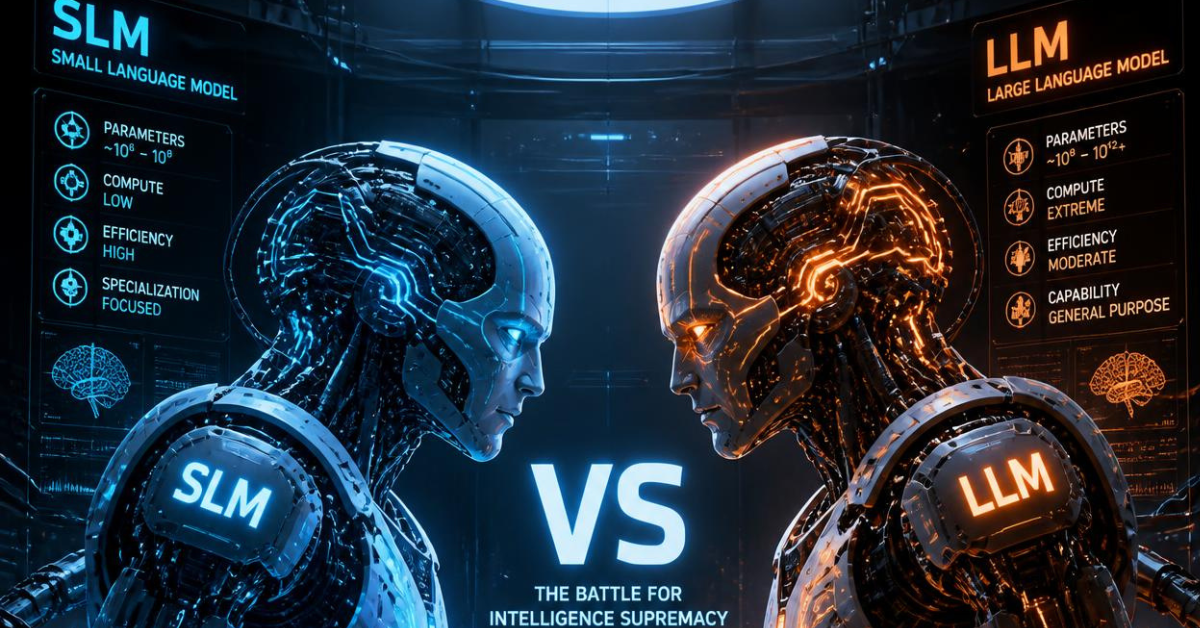


Artificial intelligence is everywhere right now. If you have chatted with a chatbot, asked an AI assistant for help, or used an AI tool to speed up your work, you have already experienced it in action. But as AI becomes more common, a new question is popping up: does bigger always mean better?
For years, Large Language Models (LLMs) dominated the conversation. They were trained on huge amounts of data and could handle a wide range of tasks. But now, Small Language Models (SLMs) are gaining attention for a different reason. They are faster, more efficient, and often cheaper to run.
That is why the discussion around SLM vs LLM is becoming so important. So, when it comes to that, which one, according to you, makes more sense? Let’s find out by studying the difference between SLM and LLM in detail.
SLM vs LLM: What are Large Language Models (LLMs)?
Large Language Models are advanced AI models trained on massive amounts of text data. They learn patterns, language rules, context, and relationships between words so they can understand and generate human-like text.
An LLM basically works like a highly knowledgeable assistant that has learned from books, articles, websites, and other text sources. Because it has been trained on such a large dataset, it can answer questions, write content, summarize information, translate languages, generate code, and hold natural conversations.
Popular examples of LLMs include AI tools Like GPT-4, Gemini, Claude, and Llama. These models are designed to handle a wide variety of tasks without needing separate training for each one.
One of the biggest strengths of LLMs is their versatility. They can switch from writing an email to explaining a complex topic in seconds. However, this capability comes at a cost. LLMs require significant computing power, memory, and energy to train and run.

ChatGPT
Starting Price
₹ 399.00 excl. GST
LLM vs SLM: What are Small Language Models (SLMs)?
Small Language Models are smaller, more focused AI models designed to perform specific language tasks efficiently. Unlike Large Language Models that are built to handle a range of requests, SLMs are optimized for particular use cases only.
These basically act as specialists. Instead of trying to know a little about everything, they are trained to do certain tasks really well, which makes them faster, lighter, and more cost effective. Besides, because SLMs are smaller, they require less computing power and memory. They can often run on local devices, edge systems, or environments with limited resources.
Common use cases for SLMs include customer support automation, document classification, data extraction, internal business tools, and industry-specific applications.
SLM vs LLM: Difference between SLM and LLM
When comparing LLM and SLM, the goal is not to find a winner. The real goal is to understand which model is better suited for a specific task. Let’s begin then, shall we…
Model Size
The biggest difference between SLMs and LLMs is their size. Small Language Models are built with fewer parameters, while Large Language Models are trained using significantly more parameters and data.
Both can get the job done, but one is designed for specific tasks while the other is built to handle a much wider range of challenges. Because LLMs learn from more data, they usually have a broader understanding of language and context.
Knowledge and Understanding
When it comes to general knowledge, LLMs have the upper hand. They are trained on massive datasets that include books, websites, articles, and other sources. This allows them to answer questions on a wide variety of topics.
SLMs, on the other hand, are often trained or fine-tuned for specific domains. As a result, they may not know as much about every topic, but they can be highly effective within their area of focus.
Speed
SLMs are generally much faster than LLMs. Since they have fewer parameters to process, they can generate responses more quickly. This makes them a great choice for applications where speed matters, such as customer support tools or real-time systems.
LLMs, on the contrary, may take longer to process requests, especially when handling complex tasks, but they often provide more detailed and nuanced responses.
Cost
Running AI models is not free, and this is where SLMs have a major advantage. Because they require less computing power, they are much cheaper to train, deploy, and maintain.
LLMs, contrarily, need powerful hardware and large amounts of processing resources, which can increase operational costs significantly. For businesses working within a budget, SLMs can be a more practical option.
Hardware Requirements
One of the main reasons SLMs are gaining popularity is that they do not require massive infrastructure. Many SLMs can run on laptops, smartphones, edge devices, or on-premises systems.
LLMs, on the flip side, usually depend on high-performance servers and cloud-based environments to function properly. This difference can have a big impact on deployment decisions.
Accuracy for Specific Tasks
Bigger does not always mean better. An SLM that has been trained for a specific purpose can sometimes outperform a larger model in that particular area. For example, a healthcare-focused SLM may provide more relevant responses for medical workflows than a general-purpose model.
LLMs are designed to perform well across many different tasks, while SLMs excel when the task is clearly defined and focused.
Reasoning and Complex Tasks
If the task requires deep reasoning, creativity, or handling multiple steps at once, LLMs usually perform better. Their larger size allows them to understand more context and make connections between different pieces of information. This is why they are commonly used for content creation, advanced coding assistance, research, and problem-solving.
SLMs can still handle many tasks effectively, but they may struggle with highly complex requests.
Fine-Tuning and Customization
SLMs are generally easier to customize. Businesses can fine-tune them using their own data without needing huge amounts of computing power. This makes it easier to create models tailored to specific industries or workflows. While LLMs can also be customized, the process is often more expensive and resource-intensive.
Privacy and Data Control
Privacy is becoming a major concern for organizations using AI. Since SLMs can often run locally, companies have greater control over where their data is stored and processed.
LLMs frequently operate through cloud services, which may require sensitive information to be sent to external systems. For industries with strict privacy requirements, this can be an important consideration.
Deployment Flexibility
SLMs are more flexible when it comes to deployment. They can be installed on mobile devices, edge systems, private servers, and other environments with limited resources.
LLMs usually require cloud infrastructure because of their size and processing demands. This makes SLMs a better fit for businesses that need AI to work in resource-constrained environments.
Scalability
As AI adoption grows, scalability becomes important. LLMs can handle a wide range of use cases across an organization, making them valuable for enterprises that need one model for many tasks.
SLMs, however, are easier and more affordable to scale for specific applications. The choice often depends on whether a business prioritizes versatility or efficiency.
Real-World Use Cases
SLMs are perfect for focused tasks such as customer support automation, document processing, workflow management, and industry-specific applications.
LLMs are better for open-ended conversations, content creation, research, coding assistance, and tasks that require broad knowledge or advanced reasoning.
Basically, neither is universally better. The right choice depends on the problem you are trying to solve.
SLM vs LLM: Which One Should You Choose?
Choosing between an SLM and an LLM depends on your needs. If your work involves simple, specific tasks and you want faster results at a lower cost, an SLM can be a better fit. For complex tasks, broader knowledge, and more flexibility, an LLM is usually the better choice.
So, go with an SLM when efficiency matters most, and choose an LLM when you need more power and versatility.
Conclusion
Think of it this way, you would not use a sledgehammer to hang a photo frame. Artificial intelligence is same. At times, you need the full power of an LLM and at others, an SLM is enough to do the job, that too at a low cost.
The key is to choose what fits your needs in the best way possible!


Written by
Yashika Aneja

Yashika Aneja is a Senior Content Writer at Techjockey, with over 5 years of experience in content creation and management. From writing about normal everyday affairs to profound fact-based stories on wide-ranging themes, including environment, technology, education, politics, social media, travel, lifestyle so on and so forth, she... Read more
 Previous