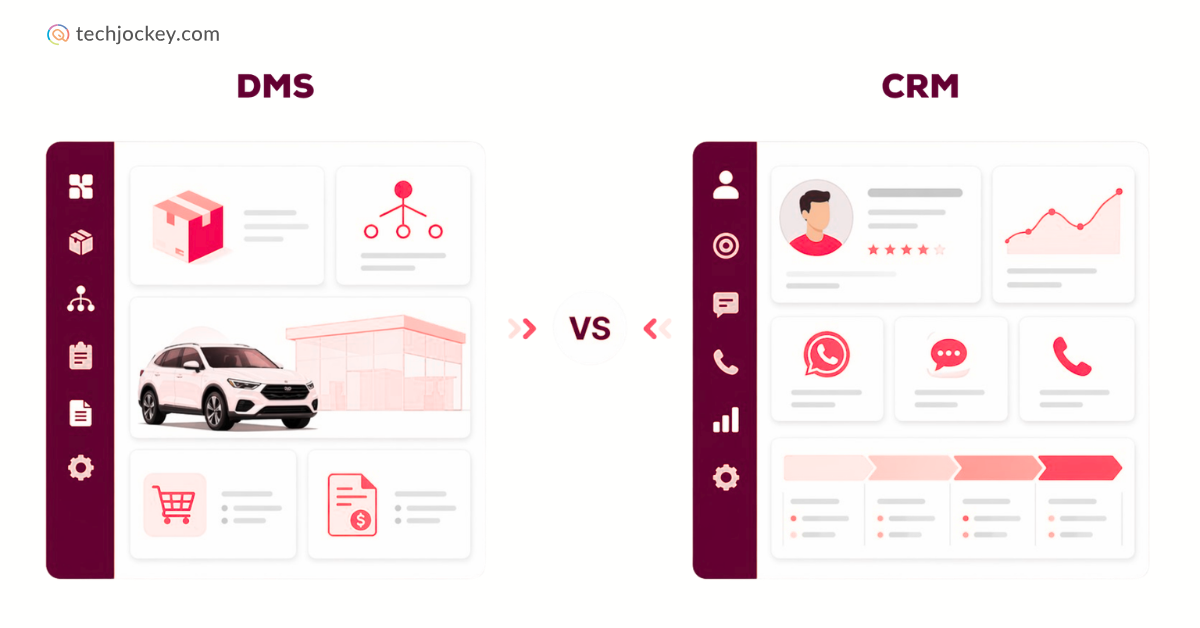
Each and every sale a business makes is the outcome of two systems, namely CRM and DMS, working together in perfect sync.
The former, short for Customer Relationship Management, focuses on winning customers, tracking leads, and closing deals. The latter, short for Dealer Management System, keeps everything running behind the scenes, be it handling inventory or managing bills and other day-to-day operations.
Often sounding similar, the two serve extremely different purposes. ‘How?’ You ask. Let’s deduce as we try and understand the real difference between CRM and DMS platforms, one key aspect at a time. For only when you know what sets the two apart, would you be able to align your sales and operations more beneficially.
A Customer Relationship Management platform is a business tool designed to serve your sales and customer service teams. It helps them keep track of, record, and save every conversation, email, text message, and meeting that takes place between your business and potential buyers.
If anything relates to a person who might buy from you, has already bought from you, or needs help after buying, it belongs inside the CRM system. The main business capabilities of modern CRM software thus include…
A Dealer Management System platform serves as a backend tool that keeps your business organized by managing inventory, executing deals, and matching up branch financial books. All of this and more to ensure your business remains legally safe at all times and is ready for audits, come what may.
The main capabilities of a DMS include…
To understand the difference between DMS and CRM systems, one must look at their core design goals, including…
Types of Business Assets Looked After
A CRM is programmed to record changing, unorganized relationship data. This includes a customer’s personal preferences, their mood during a phone call, or their past feedback about your brand.
A DMS, on the flip side, manages structured, operational business data. This includes inventory, booking records, and sales transactions.
Primary Operational Focus
CRM platforms focus heavily on external customer relationships, sales pipelines, and outward sales communications. DMS platforms, on the other hand, give priority to inventory control, billing processes, service operations, and overall dealership management.
Primary System Users
A CRM is used by front-line sales representatives, marketing professionals, and customer care executives. Conversely, a DMS serves operations managers, finance teams, inventory controllers, and service staff.
Core Metrics Evaluated
A CRM system evaluates outward metrics like lead response speed, deal win rates, and customer lifetime value. A DMS, contrarily, evaluates operational metrics like inventory turnover, billing efficiency, sales performance, and service completion rates.
Data Flow Style
Information moves inside a CRM through fast, real-time communication updates and continuous behavior changes. A DMS handles structured operational flows like inventory updates, order processing, billing cycles, and service workflows.
Nature of Business Impact
A CRM directly impacts revenue growth by improving lead conversion, customer engagement, and retention.
A DMS, on the contrary, impacts operational efficiency by ensuring smooth execution of sales, accurate inventory handling, and reliable financial processes.
End Goal
The end goal of a CRM is to build strong customer relationships and drive more sales. The end goal of a DMS, however, is to ensure the business can fulfill those sales accurately and at scale.
Choosing between DMS and CRM systems is not about finding out which platform is better. Instead, it depends on finding out where your business needs help the most.
You should get a CRM if you notice warning signs like a significant drop in leads, lack of visibility into the sales pipeline, or broken customer histories in your daily sales.
Conversely, your company needs to install a DMS if your office operations begin to show gaps, such as poor visibility into inventory, delays in billing or order processing, confusion in managing bookings and deliveries, or service teams struggling to track customer history efficiently.
If your team is small and your customer talks are easy to track, starting with a CRM helps build steady cash flow. However, as company departments grow and legal responsibilities pile up, adding an organized DMS becomes necessary to keep order.
For mid-sized and large businesses trying to achieve smooth operations, running these platforms separately can slow things down. Setting up a clean CRM DMS integration allows information to move automatically between both systems and unlocks clear business advantages.
For instance, when a sales representative opens a client profile inside the CRM, they can instantly view key operational details, like product availability, order status, payment progress, or service updates, pulled directly from the DMS without switching systems. This saves time and removes unnecessary back-and-forth.
And it doesn’t stop there. The moment a deal is marked as closed in the CRM, the DMS automatically takes over, updating inventory, processing the order, starting billing, and preparing delivery. What used to take multiple steps and teams now happens in one flow, reducing delays and errors.
At the same time, critical operational and financial data stays managed within the DMS, while the CRM provides just the right level of visibility for sales teams. This ensures better coordination across departments, faster execution, and a smoother experience from the first customer interaction to final delivery.
Conclusion
With businesses growing every minute and technology taking over every realm possible, having one single software at your disposal is not enough. So, use whatever tech helps you move a step closer to your business objectives in the most efficient way.
Both CRM and DMS indeed serve varying purposes but using them together can do wonders for your company, and how! Besides, two heads are always better than one. So, what are you waiting for? Call the Techjockey product team today itself and get your hands on the best DMS and CRM software solutions right away.
Keeping employees safe is not just legal requirement. It is also essential for smooth… Read More
Building software requires time, efforts, and money in equal measure. But if the same software… Read More
If AI tools have become part of your daily work, chances are you already… Read More
Every business needs data to run efficiently. Developers need it to test applications. Analysts need… Read More
For most enterprises evaluating VDI platform today, the real pressure points aren't operational; they… Read More
Generic paper meal plans almost never deliver lasting fitness gains for gym members. Trainers invest… Read More
