


Different laboratories operate differently. What helps a pharmaceutical lab, for instance, might end up hindering the functioning of, say, a hospital laboratory or a food testing facility for that matter. This is exactly why we have different types of LIMS.
For the unversed, LIMS, short for Laboratory Information Management System, is a software solution designed to help laboratories better manage data, track samples, automate everyday operations, and ensure regulatory compliance.
While all LIMS systems serve the same purpose more or less, some place greater emphasis on fulfilling specific laboratory needs like large volume testing, workflow automation and more. Quite evidently so, the issue isn’t deciding if your lab needs a LIMS, it is which particular type of the said tool would benefit your lab the most.
This is exactly what this guide intends to help you with. Read on as we list the different types of LIMS software for you to find your lab’s best match, one specimen at a time!
What is a LIMS?
A laboratory information management system is a software solution that helps laboratories manage their day-to-day operations in a better, much more organized manner. In doing so, it acts as a centralized hub for labs to store their important data, track samples, and monitor test results.
You can basically use LIMS to keep everything lab related in one place and say no to paperwork and manual recordkeeping. Not only does this make it easier for you to find any and every piece of information you need in this regard, but it also reduces the chances of errors that laboratories often deal with.
The software also helps laboratories stay compliant by maintaining accurate records and audit trails. It basically makes running a laboratory feel like a cakewalk.
Different Types of LIMS Software
Some of the most common types of LIMS software are listed below for your convenience. Let’s explore them one by one and understand what sets each apart…
- Types of LIMS by Deployment Model
- Types of LIMS by Software Model
- Types of LIMS by Laboratory Environment
- Types of LIMS by Core Focus
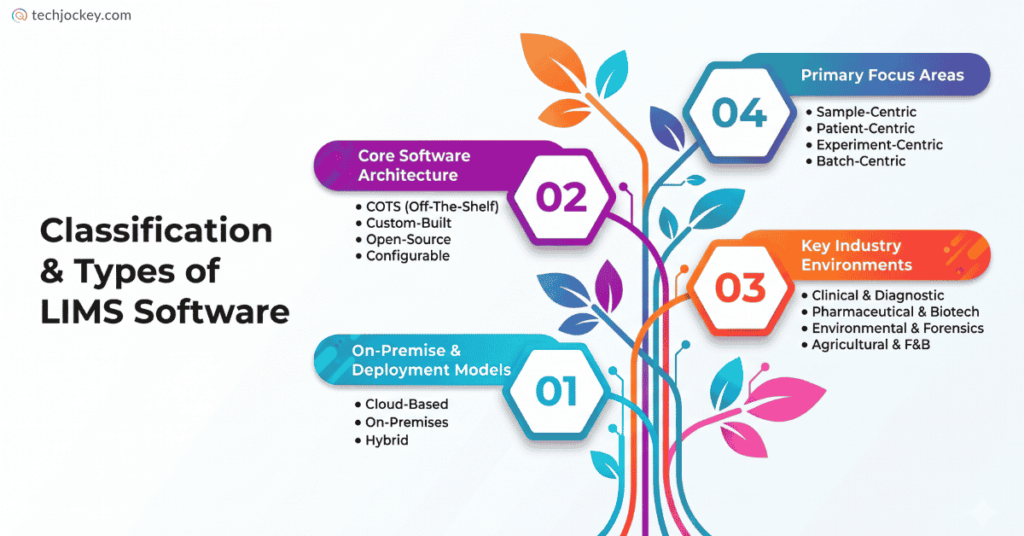
Types of LIMS by Deployment Model
Below listed are all the LIMS types based on where the software is hosted and how users access it…
- Cloud-Based LIMS
A cloud-based LIMS is hosted on the vendor’s servers, but it can be accessed using a web browser anytime, anywhere. This makes it a perfect choice for laboratories operating from multiple locations and teams working remotely.
This one also spares labs the trouble of investing in expensive IT infrastructure as software updates and maintenance are handled by the vendor in question himself.

CrelioHealth LIMS
Starting Price
$ 400.00
CrelioHealth, CloudLIMS etc., are some of the most renowned cloud-based LIMS systems.
Pros
- Can be accessed anytime and from anywhere through a web browser
- Has lower upfront costs
Cons
- Requires a stable internet connection
- Offers less control over servers and system infrastructure
- On-Premises LIMS
Unlike cloud-based LIMS, an on-premises LIMS software gets installed in a laboratory’s own servers. It is basically managed internally, giving organizations full control over their data. This makes it an ideal choice for laboratories with strict compliance and privacy requirements to fulfil.
Some of the most popular on-premises laboratory information management systems are LabWare LIMS, STARLIMS etc.
Pros
- Offers complete control over data and servers
- Can be customized as per the lab’s requirements
Cons
- Has higher upfront costs for hardware, software, and setup
- Requires an internal IT team for maintenance and updates
- Hybrid LIMS
A hybrid LIMS, as the name suggests, is a mix of both cloud-based and on-pemises deployment. Some of its functionalities run in the cloud, while others, owing to reasons of confidentiality, get stored on local servers. Using it, people get to relish the benefits of cloud access without compromising their control over critical information.
LabVantage LIMS, Sapio LIMS etc., are some of the well-known solutions in the hybrid LIMS category.
Pros
- Allows laboratories to keep sensitive data on site while using cloud features
- Can be adapted to different business and compliance requirements
Cons
- Can be expensive to implement and maintain
- Is more difficult to set up and manage
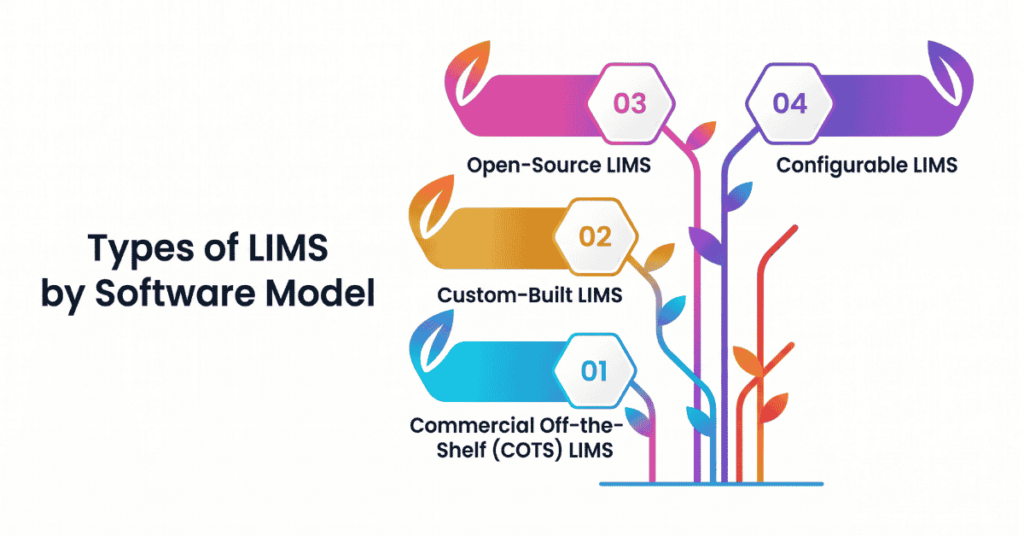
Types of LIMS by Software Model
The following laboratory information management systems are classified on the basis of how they are developed and deployed to meet the requirements of various laboratories…
- Commercial Off-the-Shelf (COTS) LIMS
A Commercial Off-the-Shelf or COTS LIMS is akin to a ready-made cloth you purchase from the market. The software is built keeping in mind the common needs of a laboratory, so it covers basic functions including sample tracking, reporting, workflow automation, and data storage.
Since the software is already developed, it gets implemented quickly too, making it affordable enough for all. Some of its leading examples are Matrix Gemini LIMS Express, SampleManager LIMS etc.
Pros
- Is comparatively faster to implement as it already developed and ready to use
- Costs less than building a custom LIMS from scratch
- Gets regular updates and support from the vendor
Cons
- Is not configurable enough
- Requires the labs to rely on the vendor for updates
- Might offer some irrelevant, unwanted features
- Custom-Built LIMS
A custom-built LIMS, on the contrary, is specifically developed to meet the requirements of a particular laboratory’s workflows and processes. This makes the software configurable enough, but at the same time, also increases its cost. Not to mention the time and technical expertise required for teams to implement and use it properly.
Pros
- Offers more customization than most off-the-shelf LIMS
- Can be easily modified to meet the growing needs of a lab
Cons
- Is expensive to both develop and maintain
- Its implementation can take longer than ready-made solutions
- Requires ongoing technical support for updates and fixes
- Open-Source LIMS
An open-source LIMS, as the name implies, gives laboratories full access to the software’s source code. Owing to this, teams get to customize the platform as per their needs. Though this reduces its licensing costs significantly, it, at the same time, also means laboratories need dedicated technical resources for implementation and ongoing support.
OpenLIMS, MetaLIMS, Bika LIMS etc., are some of the leading specimens of open-source laboratory information management systems.
Pros
- Gives laboratories full access to the source code
- Has lower licensing costs than other commercial solutions
Cons
- Offers limited support
- Requires technical expertise for set up and maintenance
- Configurable LIMS
A configurable LIMS, just like hybrid LIMS, offers laboratories a mix of both ready-made and custom-built functionalities. This, so they can use its built-in settings to customize workflows, dashboards, and reports as per their needs without having to develop a completely new system from scratch.
Due to this, the software becomes more accommodating than a typical off-the-shelf solution and less costly than a custom-built LIMS system.
Pros
- Can be adjusted to meet different laboratory needs
- Offers quick deployment
Cons
- Can be expensive if multiple customizations are needed
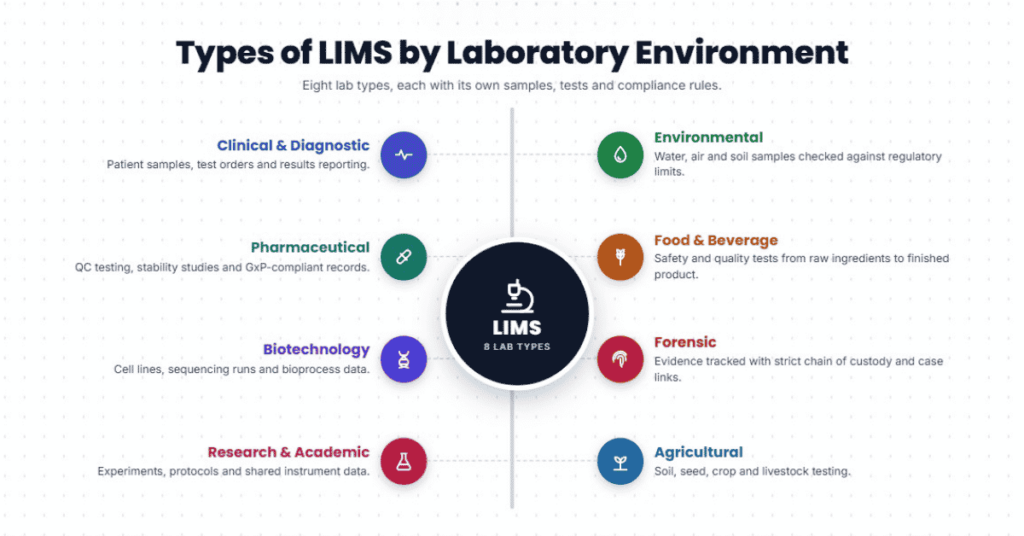
Types of LIMS by Laboratory Environment
The following is a list of different types of LIMS based on the industry they are intended to serve…
- Clinical & Diagnostic LIMS
Clinical and diagnostic LIMS, also commonly referred to as Laboratory Information Systems (LIS), are designed to assist hospitals, diagnostic labs, and healthcare facilities. These help teams keep track of and manage patient samples, test orders, results, and reports in a better way, all while ensuring faster turnaround times for patient test results.
Clinisys, TrakCare Lab Enterprise etc., some of the leading examples of clinical and diagnostic LIMS systems.
Pros
- Helps laboratories manage patient samples and test results more efficiently
- Improves accuracy as it’s specifically built to serve diagnostic facilities
Cons
- Requires staff training before it can be used effectively
- Its integration with existing healthcare systems can be challenging
- Pharmaceutical LIMS
Pharmaceutical LIMS, as the name suggests, is programmed to serve drug development, manufacturing, and quality control labs. It helps them better manage testing activities and ensure compliance with strict industry regulations in place.
Some of its most popular specimens include LabWare LIMS, Thermo Scientific SampleManager LIMS etc.
Pros
- Helps pharmaceutical laboratories manage samples and test results more efficiently
- Supports compliance with industry regulations and quality standards
Cons
- Requires training for optimal use
- Biotechnology LIMS
Biotechnology LIMS is a laboratory information management software designed to support laboratories working with biological samples, genetic testing, and biotechnology research. Sapio Sciences, Labguru, LabKey Biologics LIMS etc., are some of its biggest names in the market.
Pros
- Helps manage large volumes of research data
- Supports collaboration between research teams and laboratories
Cons
- Can be expensive to implement
- Requires training to use all features
- Research & Academic LIMS
This is a type of LIMS that gets used in universities, research institutes, and R&D facilities. It lets researchers keep track of their experiments and organize research data throughout a project’s lifecycle. Genemod, LabArchives etc., are some of the most well-known research and academic laboratory information management systems available in the market.
Pros
- Helps organize research data, samples, and laboratory records in one place
- Makes it easy for students, researchers, and teams to collaborate
Cons
- Requires training
- It might require customization to support specific research projects
- Environmental LIMS
Environmental LIMS is specifically programmed to serve laboratories that test soil, water, air, and environmental samples. In a bid to help them achieve the same, it manages large sample volumes, all while maintaining regulatory compliance through and through.
CloudLIMS, LabLynx LIMS Suite etc., are some of environmental LIMS’ most renowned examples.
Pros
- Helps labs handle large volumes of environmental samples and testing data
- Helps labs stay compliant with environmental regulations
Cons
- Can be expensive to implement
- Requires training for effective use
- Food & Beverage LIMS
Food and beverage LIMS helps laboratories working in the field monitor the quality and safety of a food item or beverage. To attain the same, it supports ingredient testing, quality assurance, batch tracking, and compliance with food safety regulations. Some of most famous food safety LIMS are Agilab, LabLynx etc.
Pros
- Helps laboratories track raw materials and finished products more efficiently
- Improves product quality by standardizing testing processes
Cons
- Can be costly
- Requires staff training
- Forensic LIMS
Forensic LIMS, true to its name, is a LIMS designed for crime labs and forensic agencies, so they can track evidence, document test results, and maintain chain-of-custody records throughout investigations. Crime Lab LIMS, Confiesnce Forensic LIMS etc., are some tools in the category that you can witch to if you run a forensic lab that is.
Pros
- Helps laboratories maintain a clear chain of custody for evidence and samples
- Improves accuracy by reducing manual data entry
Cons
- Requires training to ensure proper use
- Strict compliance and documentation requirements can increase setup time
- Agricultural LIMS
This laboratory management tool is used by labs that conduct soil, crop, seed, fertilizer, and agricultural product testing. It ensures efficient sample tracking and testing, so farmers, researchers, and agricultural organizations get reports that can be trusted and upon.
Some of agricultural LIMS’ most famous specimens are LABWORKS agLIMS, Qualis LIMS, Revol LIMS etc.
Pros
- Helps laboratories manage agricultural samples and test results in a better way
- Improves traceability of seeds, soil samples, fertilizers, and crop testing activities
Cons
- Can be expensive for small laboratories with limited budgets
Types of LIMS by Core Focus
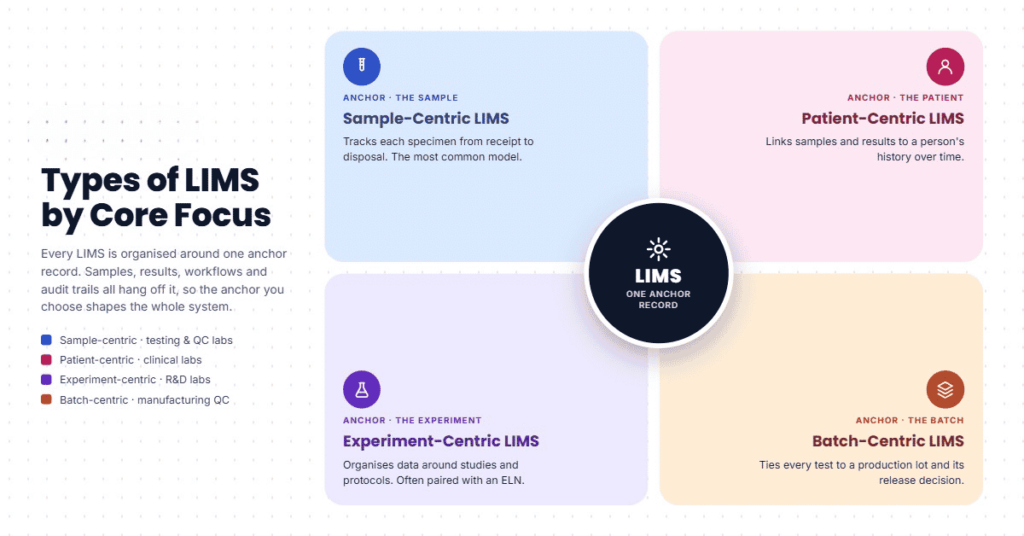
Some LIMS types are classified based on what they primarily track and manage. Read on to know how…
- Sample-Centric LIMS
A sample-centric LIMS is designed to help labs gain mastery in sample management. It tracks samples right from collection and testing to storage and final disposal. Owing to which, it is one of the most widely used types of laboratory information management system across industries.
LIMSey, QBench, LabWare LIMS etc., are some of its leading examples.
Pros
- Improves sample tracking
- Reduces the risk of lost or misplaced samples
- Helps labs handle large volumes of samples easily
Cons
- Mainly focuses on sample management
- May require additional modules for other laboratory functions
- Patient-Centric LIMS
A patient-centric LIMS focuses on patient records and diagnostic workflows rather than individual samples. It helps healthcare laboratories manage patient information, test requests, and medical reports in a much more effective manner. If you are looking for one such LIMS, CrelioHealth LIMS, CloudLIMS etc., are some options that you can explore.
Pros
- Helps labs maintain all patient records, samples, and test results in one place
- Improves patient data tracking
Cons
- Requires strong data security and privacy controls
- Experiment-Centric LIMS
An experiment-centric LIMS is built for research-driven environments. Instead of focusing primarily on samples, it tracks research projects, observations, and findings. Benchling, Illumina Clarity LIMS, etc., are some tools you can use if you are looking for an experiment-centric LIMS.
Pros
- Keeps all experiment-related data organized in one place
- Makes it easier to track research progress and results
- Improves collaboration between researchers and laboratory teams
Cons
- Is more focused on experiments than routine lab operations
- May require customization for different research projects
- Batch-Centric LIMS
A batch-centric LIMS is programmed to focus on production batches and manufacturing lots. It helps laboratories monitor quality control activities, track testing records, and ensure consistency across production runs. This makes it particularly useful for laboratories involved in pharmaceutical, chemical, and food manufacturing processes.
Pros
- Makes batch status monitoring and recordkeeping easy Helps laboratories manage and track batches in a more effective way
- Helps laboratories manage and track batches in a more effective way
Cons
- Focuses more on batch management instead of individual samples
- It may not be suitable for labs where each sample follows a different testing process
Conclusion
Just because a laboratory functions in a certain way does not mean another one in the same field or different would flourish doing the same. The same goes for the LIMS software they need to simplify their processes.
To each its own, we say and so does the market with so many different types of LIMS available to fulfil your lab’s needs. If you wish to lay your hands on one, know that all you need to do is pick up your phone and give the Techjockey product team a call. We will take care of the rest!
Was that a trring we just heard?
FAQs on Types of LIMS
What are the four main types of laboratories?
The four main types of laboratories are clinical and diagnostic laboratories, research laboratories, pharmaceutical laboratories, and environmental testing laboratories. Each serves a different purpose, from diagnosing diseases and developing new medicines to conducting scientific experiments and testing environmental samples. The type of laboratory determines the kind of LIMS software and features it may need.
What type of software is LIMS?
LIMS, short for Laboratory Information Management System, is a specialized laboratory management software designed to help laboratories manage data, track samples, automate everyday operations, and maintain regulatory compliance. It acts as a centralized hub for storing laboratory information, monitoring test results, and maintaining accurate records. Depending on the lab’s requirements, LIMS can be cloud-based, on-premises, hybrid, commercial, or open-source.
What is the difference between commercial and open-source LIMS?
A commercial LIMS is a licensed software solution developed and provided by a vendor, usually with technical support, regular updates, and ready-to-use features. An open-source LIMS, on the other hand, gives laboratories access to its source code, allowing them to customize the software as per their needs. While open-source LIMS can reduce licensing costs, it may require dedicated technical expertise for implementation, maintenance, and ongoing support.


Written by
Shobhit Kalra

Shobhit Kalra boasts an impressive 12 years of diverse experience across industries, including Digital Media, Digital Marketing and Healthtech. He has a proven track record of creating engaging and impactful content that resonates with readers. In his journey with Techjockey, he has been given the responsibility of crafting... Read more
 Previous


