Ever signed up for an app and got stuck in a long verification process?
What if your identity strategy is slowing down your business growth? For many business leaders, it’s not just a technical glitch but a major challenge that loses trust, revenue, and missed opportunities.
But here’s the catch
As your user base grows, so do the risks of identity fraud and account takeovers, which increase compliance expectations for data privacy. Balancing this with complex identity legacy systems is a challenge. Here comes customer identity and access management (CIAM) that centralizes identity data, implements security, and builds smooth onboarding journeys while maintaining trust at every interaction.
In this blog, let’s understand what CIAM is, how it works, and how CIAM compares to traditional IAM. Along with its best practices and use cases that every business should evaluate.
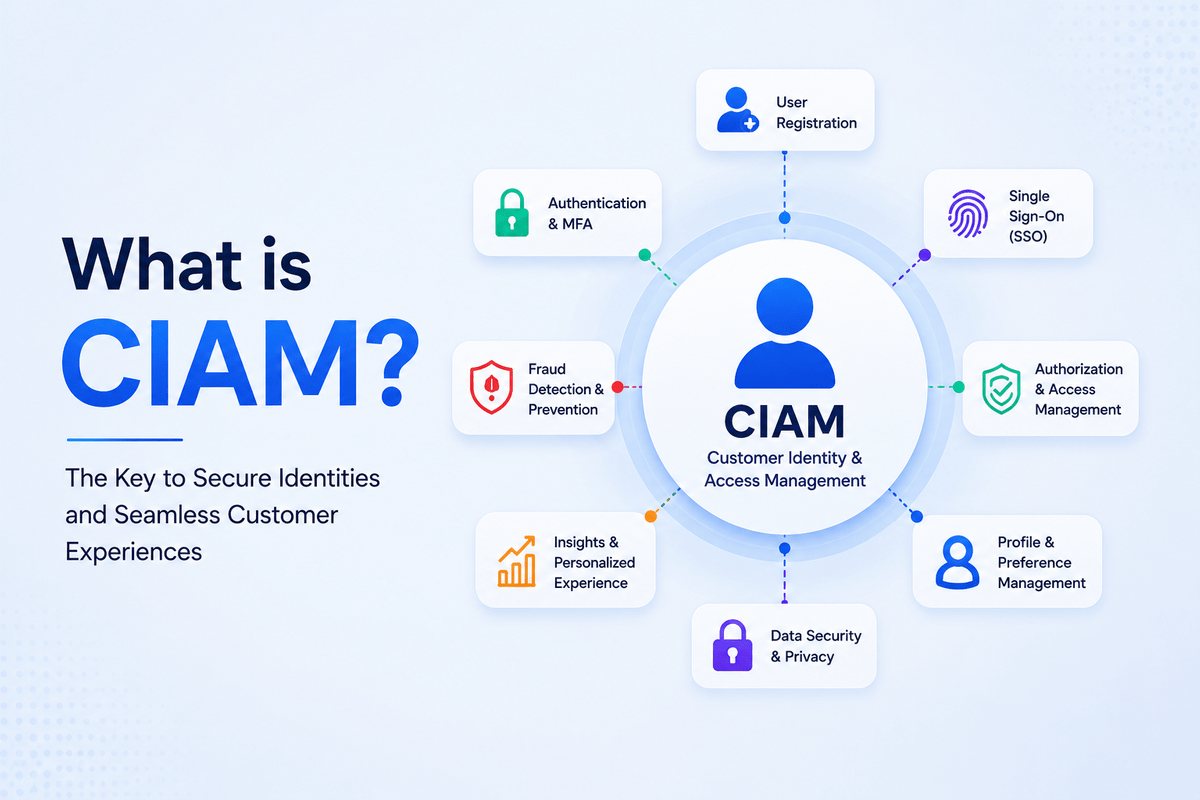
Customer identity and access management is a system that manages your account creation, secures across websites, and integrates authentication. It performs customer-facing preference management and authorization. CIAM performs below essential tasks.
Every business is moving forward to maintain a fine balance between a smooth customer experience and protecting its sensitive information. The very first digital interaction with your customer is signing up, which gives importance to a customer’s identity for a business whose main purpose is to attract, engage, and retain the target customer.
CIAM solutions help your customers facilitate personalized user experience at every touch point of their journey across omnichannel networks. This solution allows your business to discover where customers are, their interactions, whether on a computer, a TV, or any smart home device.
Once you gather these insights, you can understand and analyse customer behaviour, set preferences, and deliver enhanced customer service. CIAM helps you gain a higher retention rate and build customer trust that generates higher revenue for your business.
CIAM works as a centralized layer that works between a company’s application, websites, IoT devices, and its users. This source is designed to oversee, analyse, gather, and handle user data. Here is the breakdown of how the CIAM customer cycle actually works from every touchpoint.
The CIAM vs identity and access management (IAM) may seem similar, but in reality, they serve different purposes for different audiences and business goals. IAM is built to manage the organization’s access. On the other hand, CIAM is made to support partners, citizens, and customers. Choosing the right approach can directly enhance security, scalability, and customer experience.
| Aspect | CIAM | IAM |
|---|---|---|
| Primary Users | Customers (external users) | Employees & internal users |
| Focus | User experience + security | Security + access control |
| Scale | Built for millions of users | Limited to organizational size |
| Login Experience | Seamless, fast, low-friction | More secure, often complex |
| Authentication Methods | Social login, OTP, passwordless | Passwords, MFA, enterprise authentication |
| Data Handling | Customer data, preferences, and consent | Employee roles and permissions |
| Compliance | Privacy-first (DPDP, GDPR) | Internal policies and governance |
| Integration | Websites, mobile apps, APIs | Internal systems and enterprise applications |
CIAM scale effortlessly to millions, delivers personalized logins, and captures profiles for tailored experiences. Adopting CIAM provides marketing insights for data-driven decision-making with seamless integration.
Here are the top six advantages of CIAM over traditional IAM:
Picking the right CIAM for your business requires a clear understanding of your business requirements, tech stack, and goals. Below are the key criteria to evaluate the right CIAM for your business.
Conclusion
As you have explored through this blog, from understanding what CIAM is, how it works, and comparing it with traditional IAM. Businesses need a scalable and customer-first approach to strengthen security, enable personalization, simplify user journeys, and stay compliant.
Businesses must ensure that scalability, user experience, security, and compliance are all addressed without compromise. Moreover, adopting CIAM reduces risks, manages identities, and supports long-term business growth.
Get in touch with the Techjockey team today and explore the right CIAM solution as per your business requirements.
Construction projects rarely encounter trouble because of single major mistake. More often, delays grow… Read More
FP&A, short for financial planning and analysis, wasn’t exactly something finance teams looked forward to… Read More
Employee management turns overly challenging when growing company must also deal with rising compliance… Read More
Urban housing communities across India have transformed significantly over the past decade. Large gated communities… Read More
Larger companies (or businesses) often struggle with scattered employee records. Human resources maintain onboarding documents,… Read More
Ever got stuck while surfing website, praying and hoping someone could just step in… Read More
