What is ITR-1 (Sahaj Form): Eligibility, Who Can File & Due Date AY 2026-27


Filing Income Tax Returns (ITR) is important for every individual to keep financial records sorted. It not only has compliance benefits but also helps in applying for loans, visas, or other financial planning.
As not all taxpayers have the same income or source of income, the Government has designed different types of ITR forms.
One such is the ITR-1 form or ITR Sahaj form. It is one of the simplest and most widely used ITR forms. This blog will clear everything about ITR-1, its meaning, who ITR-1 is for, and its filing due date.
What is ITR-1 (Sahaj Form)?
ITR-1 is for salaried employees and resident individuals (not an NRI or RNOR) who earn a total income less than or equal to INR 50 lakh. It is also known as the Sahaj Form. This form is specifically made for taxpayers who have limited and straightforward sources of income.
Who is Eligible to File ITR-1?
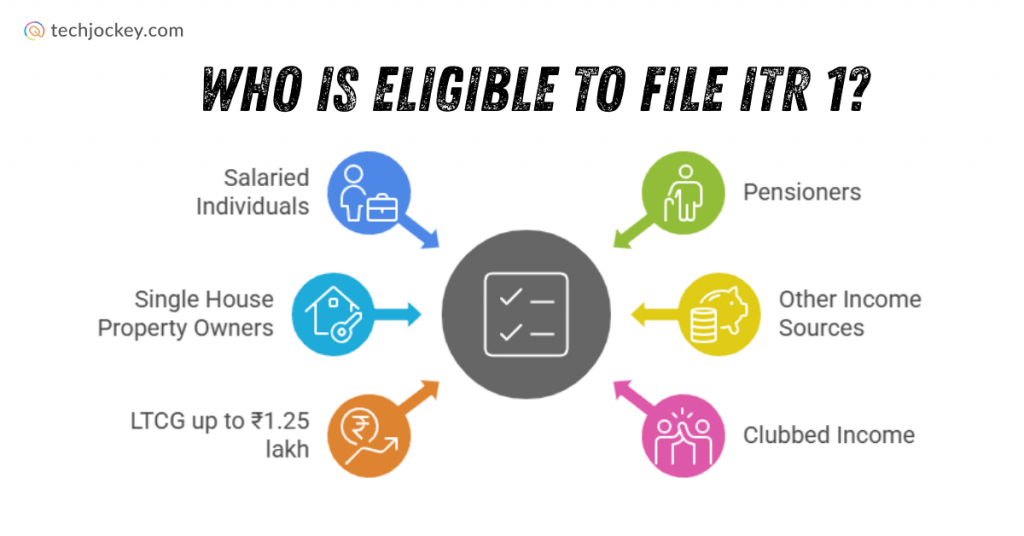
ITR-1 (Income Tax Return Form 1) or Sahaj serves individuals who:
- are a resident individual.
- total income does not exceed ₹ 50 lakh during the FY.
- income sources include salary, one house property, family pension income, agricultural income (up to INR 5,000), and certain long-term capital gains u/s 112A up to INR 1.25 lakhs.
- other sources like interest on savings accounts, deposits (Bank / Post Office / Cooperative Society), or income tax refunds.
- income of spouse (other than those covered under Portuguese Civil Code) or Minor is clubbed (only if the source of income is within the specified limits)
- do not have income from business, profession, lottery, racehorses, legal gambling or more than one house property.
In short, ITR-1 is ideal for individuals who do not have complicated income structures.
Fun fact: The word Sahaj in Hindi means simple. True to its name, this form makes tax filing quick and easy for eligible taxpayers.
Who Cannot File ITR-1?
As every form is designed for different taxpayers, not everyone can file ITR-1. You cannot file ITR-1 if you:
- are a non-resident (NRI) or resident but not ordinarily resident (RNOR).
- income exceeds INR 50 lakh.
- have income from more than one house property.
- agricultural income exceeding INR 5000/-
- have capital gains exceeding the limit or from sources like unlisted equity shares.
- have taxable capital gains (short term and long term)
- have income from a business or profession, or if you are a company director.
- have invested in unlisted equity shares.
- have tax deduction under section 194N of Income Tax Act.
- have deferred income tax on ESOP received from employer being an eligible start-up.
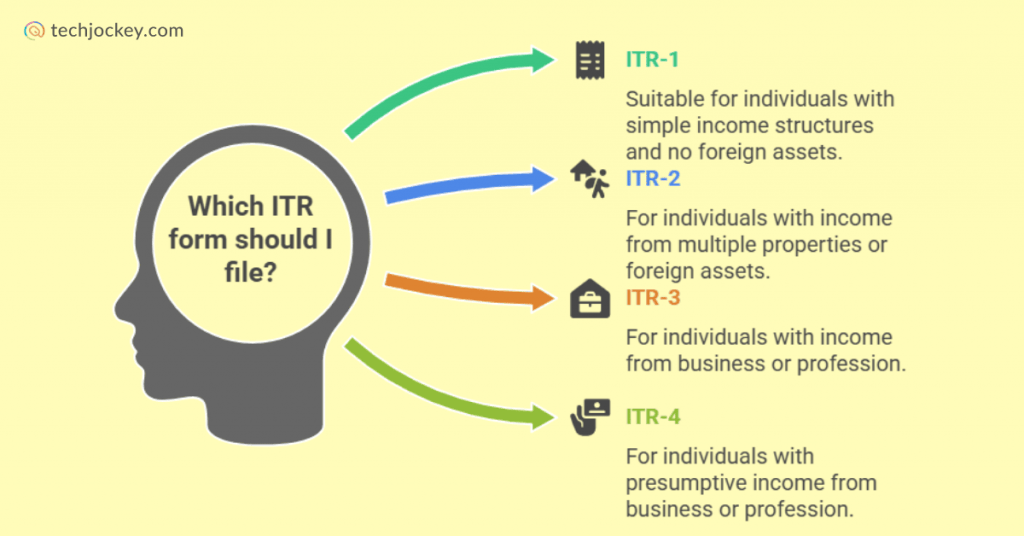
It is important to note that if your income is diverse, complex, or involves foreign elements, you must opt for other ITR forms such as ITR-2, ITR-3, or ITR-4, depending on your case.
Suggested Read: Breaking Down the New Rules for Income Tax in India
Last Date to File ITR-1 for FY 2025-26
The last date to file ITR-1 for the financial year 2025-2026 is 31 July 2026. However, the due date can be extended as per government directions.
What’s good is that you should file your ITR-1 before the due date to avoid penalties.
Pro Tip: You can use an income tax software to make the job of filing ITR-1 easy. These third-party tax software simplify calculations, reduce errors, and help you claim maximum deductions.
Suggested Read: Income Tax for Freelancer: Self Employment Tax Benefit & Deduction in India
Final Thoughts
Salaried individuals and pensioners with simple incomes can file their income tax returns through ITR 1 or the Sahaj form.
However, you must closely keep a check on the ITR-1 eligibility criteria before filing. An incorrectly chosen ITR form can render your return invalid.
Here’s the summary:
- ITR 1only to be used if your income is up to INR 50 lakh or is from one house property or other simple sources.
- ITR-1 is not to be used if you have business income, more than one property, foreign property, or crypto gains.
- It is best to file ITR-1 on or prior to deadline to avoid a penalty.
By being a responsible taxpayer and filing your return on time, you not only perform your duty as a taxpayer but also benefit from easy loans, quick refunds, and peace of mind.
FAQs on ITR-1
What are the types of income that shall not form part of ITR-1 form?
Any capital gains, earnings from a business or profession, or income from multiple house properties and lottery are not part of the ITR-1 form.
Can NRIs file ITR-1?
No, ITR-1 is only for residents of India.
What is the salary limit for ITR-1?
The salary limit for the ITR-1 form is up to INR 50 Lakh, which includes salary, one house property, and other sources except lottery or horse races.
If I am a joint owner of a house property, can I file ITR-1?
No, joint owners of any house property cannot file ITR-1; they must use ITR-2 or any other related form.
Should salaried employees file ITR-1?
Yes, salaried employees with income up to INR 50 lakh should file ITR-1.
How do I know if I have ITR-1 or ITR-2?
If you earn only from one salary, have one house property, and earn within the limit of INR 50 lakh, then you have to file ITR-1; otherwise, go for ITR-2.
Is ITR-1 or 4 for salaried employees?
ITR-1 is for salaried employees; ITR-4 is mainly for individuals with presumptive business or professional income.


Written by
Mehlika Bathla 
Mehlika Bathla is a passionate content writer who turns complex tech ideas into simple words. For over 4 years in the tech industry, she has crafted helpful content like technical documentation, user guides, UX content, website content, social media copies, and SEO-driven blogs. She is highly skilled in... Read more
 Previous