USA
USA UAE
UAESmall Business
Designed for startups and growing businesses


See More




Brand: Oracle
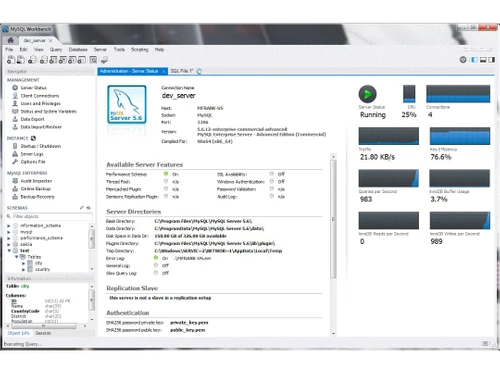
MySQL is a fast, reliable, and scalable open-source relational database, built for seamless integration across a wide range of programming languages and platforms.
See MoreHave you used Mysql before?
Share your insights for better experience
Brand: Oracle
Founded Year: 1977
Oracle is an integrated cloud application and platform services that sells a range of enterprise information technology solutions.
Looking for The Right Pricing?
Share your requirements and get a plan built around your business.
Price Available on Request
Get personalised Mysql pricing that fits your needs. Our team will connect with you.
 Real Time Analytics Separate Analytics Databases Cost Reduction Error Recovery Auto Query Improvement Auto load Laoding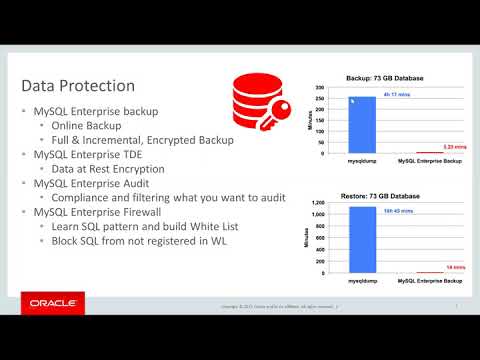

Watch the demo video to explore key features, real workflows, and how the software fits your business needs.
 Windows
  MacOS
MacOS  Desktop
  Cloud-Based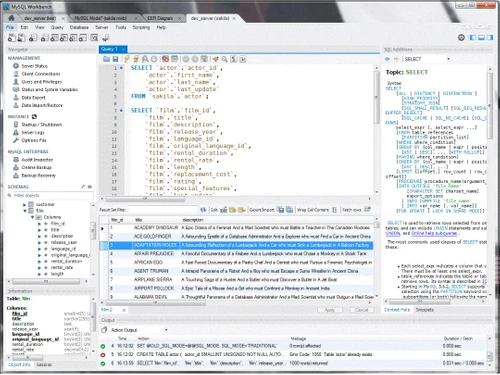
Small Business
Designed for startups and growing businesses
Medium Business
Built for business growth and flexibility
Enterprises
Designed for complex and large-scale business needs
4.2
Out of 5

Overall Rating
Based on
3 Verified Ratings
Rating Breakdown
86% Recommend this Product
Add ReviewTechjockey Trusted Reviews from Verified Users
No reviews are currently available for Mysql. Discover similar Data Management Software reviews

MagicBot
Whats great - “I’m no accounting expert and yet l I’ve had no problems to feel comfortable using SlickPie” read more

Mink InfoTech Data Extraction System
Whats great - Good software to use saved my time by extracting data in a pattern, and saving in a file. The software requires no technical ... read more

WeighMAST
Whats great - The system integrates seamlessly with your organization. Its key strength is the ability to be customized with features and w... read more

Mysql
Price On Request
Desktop
Mobile
Web based
On Premises
Windows
Mac OS

iTransor for Whatsapp
₹ 4163
Desktop
Mobile
Web based
On Premises
Windows
Mac OS

Dancing Numbers
Price On Request
Desktop
Mobile
Web based
On Premises
Windows
Mac OS

Zoho DataPrep
₹ 28800
Desktop
Mobile
Web based
On Premises
Windows
Mac OS

OpenRefine
Price On Request
Desktop
Mobile
Web based
On Premises
Windows
Mac OS

Zapper Edge
Price On Request
Desktop
Mobile
Web based
On Premises
Windows
Mac OS

Squeezely
Price On Request
Desktop
Mobile
Web based
On Premises
Windows
Mac OS

Teamscope
Price On Request
Desktop
Mobile
Web based
On Premises
Windows
Mac OS

Tibco Rendezvous
Price On Request
Desktop
Mobile
Web based
On Premises
Windows
Mac OS

Harmonize
Price On Request
Desktop
Mobile
Web based
On Premises
Windows
Mac OS

Anomalo
Price On Request
Desktop
Mobile
Web based
On Premises
Windows
Mac OS
(0) Product(s) selected
Available
Price on Request
Available
Price on Request
Starting Price:
€399 /year
Available
Price on Request
Available
Price on Request
Available
Price on Request

Starting Price:
€20
Available
Price on Request
Available
Price on Request

Available
Price on Request

Available
Price on Request
Mysql Data Management Software demo is available for free at Techjockey.
Mysql Data Management Software offers a free trial. However, the premium plan with advanced features available at Techjockey.
For Mysql Data Management Software installation, insert the given CD/USB flash storage in your system and open the Setup Wizard to get started.
MySQL is a fast, reliable, and relatively inexpensive database management software used to store and manage data for various applications. It is widely used because it integrates easily with many programming languages and is known for its easy scalability.
SQL (Structured Query Language) is the standard language used to communicate with and manage databases, while MySQL is a specific relational database management system (RDBMS) that uses SQL. In essence, SQL is the language, and MySQL is the software platform where you use that language.
Yes, a free community version of MySQL is still available for general use and contributions. However, since its acquisition by Oracle, there are also paid enterprise versions with increased features and support.
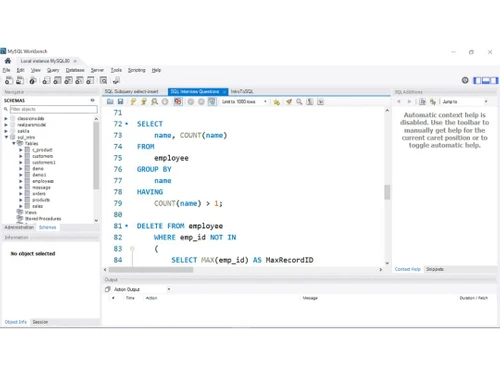
To start a MySQL database, you first need to install the MySQL server software on your system and then use a command-line client or a graphical tool to connect to the server. Once connected, you can create a new database using the CREATE DATABASE SQL command.
MySQL is a database management software, not a language. It uses SQL (Structured Query Language) to manage the data stored within its databases.
MySQL pricing details are available on request at techjockey.com.
Yes, MySQL is considered a highly suitable option for growing businesses due to one of its most prominent features, which is easy scalability.
MySQL is designed for flexibility and can easily integrate with a wide variety of popular programming languages.
Yes, for business purchases made through participating sellers, you can receive a GST invoice provided your GSTIN and business details are accurate and the product is eligible.
20,000+ Software Listed
Best Price Guranteed
Free Expert Consultation
2M+ Happy Customers
Terms and Condtions

Users with registered businesses can purchase goods from merchants on the platform to satisfy their business needs. Users are not permitted to utilize any products acquired through the platform for resale, advertising, business, or further distribution.
For each purchase made, users will receive a Tax Invoice (or 'GST invoice') that includes specific details such as:
the GSTIN of the user associated with their registered business, and
the specified Entity Name for their business.
It should be noted that not all products are eligible for GST Invoice. Only the products displayed by participating sellers with the 'GST-based Invoice Available' callout on the product description page would qualify.
Certain goods and services are not eligible to get a GST Invoice, including items with VAS, i.e., Value Added Services (e.g., Total Mobile Protection/Assured Buyback) and those involving an exchange offer at the time of purchase.
Users must ensure the accuracy of the GSTIN, and business entity name provided for the GST Invoice. Requests for corrections into GST Invoice would not be accommodated by Techjockey.com or any Seller, and any issues arising from user-provided information are the sole responsibility of users.
Techjockey.com is not liable for the GST Invoice or any associated input tax credit. To efficiently claim an input tax credit, users should select the registered place of business address as per the GST authority's data and follow the provisions of the GST Act and rules.
To claim an input tax credit, the delivery and billing addresses must match. Furthermore, input tax credits will not be granted if the delivery address and GSTIN on the invoice are from different states. In case of incorrect GST details provided during the order placement, the order will be canceled automatically.